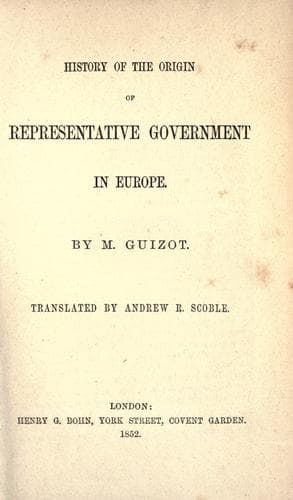
History of the Origin of Representative Government in EuropeGuizot, François
History
History of the Origin of Representative Government in Europe
Guizot, François
Europe -- History; Representative government and representation
IV. Beneficiary property was one of the most influential
principles in the formation of large societies. In the absence of
public assemblies and of a central despotism, it nevertheless
established a bond, and formed relations between men dispersed
over a vast tract of country, and thereby rendered possible a
federative hierarchy, which should embrace a still wider circle.
Among the nations of antiquity, the extension of the State was
incompatible with the progress of civilization; either the State
must be dislocated, or despotism would prevail. Modern States
have presented a different spectacle, and to this result the
character of beneficiary property has powerfully contributed.
{132}
Lecture XVI.
Of the state of persons, from the fifth to the tenth century.
Impossibility of determining this, according to any fixed and
general principle.
The condition of lands not always correspondent with that of
persons.
Variable and unsettled character of social conditions.
Slavery.
Attempt to determine the condition of persons according to
the _Wehrgeld_.
Table of twenty-one principal cases of _Wehrgeld_.
Uncertainty of this principle.
The true method of ascertaining the condition of persons.
Classification Of Persons.
We have investigated the condition of territorial properties,
from the fifth to the tenth centuries. We have recognized three
kinds of territorial property. _First_, allodial or
independent; _Secondly_, beneficiary; _Thirdly_,
tributary. If from this we should wish to deduce the state of
persons, we should find three social conditions corresponding to
these: _First_, the free men, or proprietors of allods,
bound to, and dependent upon no one, excepting the general laws
of the state; _Secondly_, vassals, or proprietors of
benefices, dependent in certain respects upon the noble from whom
they held their property, either during life or hereditarily;
_Thirdly_, the proprietors of tributary lands, who were
subject to certain special obligations. To which it is necessary
to add a fourth class, namely, the serfs.
We should observe further, that the first of these classes tended
to disappear and become absorbed in the second, third, and even
the fourth classes. This arose from facts which we have already
explained.
This classification of persons is in fact a real one, and is to
be met with in history; but we must not regard it as a primitive,
general, and perfectly regular classification.
The condition of persons preceded that of lands;--there were free
men before there were freeholds; there were vassals and
associates before benefices. The condition and relations of
persons did not therefore originally depend on the condition and
relations of territorial properties, and cannot be deduced from
them.
{133}
Earliest Condition Of Society.
Public-domain text, read in full here on John Shaqi.
Reviews
Reviews
No reviews yet
Be the first to share your thoughts on this work.
Elsewhere in the archive
Join the Discussion
Join the discussion
Sign in to leave a comment or review.
Sign InorCreate an account