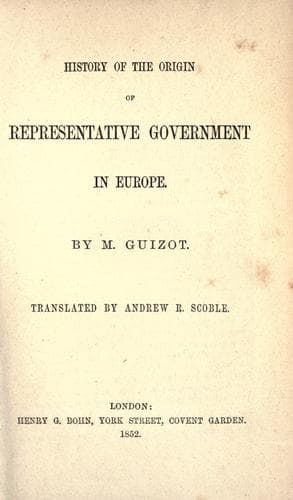
History of the Origin of Representative Government in EuropeGuizot, François
History
History of the Origin of Representative Government in Europe
Guizot, François
Europe -- History; Representative government and representation
Historians have fallen into a double mistake on this point. Some
have wished to see in all the Franks, before the conquest, and
the establishment of the system of landed estates, which we have
already explained, men altogether free and equal, whose liberty
and equality for a long time resisted the formation of this
system. Others have been unwilling to recognize men as free,
except as they are beheld in the condition of land proprietors,
whether as allods or as benefices.
The matter is not thus simple and absolute. Social conditions
were not thus framed and disposed of by a single process, to suit
the convenience of subsequent antiquarians.
What do we find to be the character of liberty in the infancy of
societies? Might is its condition, and it has scarcely any other
guarantee. So long as society is of small extent and firmly
compacted within itself, individual liberty remains, because each
individual is important to the society of which he is a member:
this was the case with the German tribes in its warrior bands of
men. In proportion as society extends and disperses itself, the
liberty of individuals is endangered because their personal
strength is insufficient for their own protection. This was
illustrated by the case of the Germans who established themselves
in Gaul. A large number of his associates lived in the house of
the chief, without being themselves proprietors or being anxious
to become so, for which indifference they were indebted to that
want of foresight which is natural to uncivilized men. Property
became a prominent instrument for attaining force, yet many free
men did not possess any.
The progress of civilization removes the guarantee of individual
liberty from the power of the individual himself, and places it
in the power of the community. But the very creation of such a
public power, and the guarantee thereby of individual liberties,
is a gradual and difficult process: it results from a social
culture which is of slow growth and must triumph over many
obstructions. Wherever there is no power belonging to the
community, individual liberties have no guarantee for their
continuance.
Hence the error of those who seek for liberty in the infancy of
societies. We do in fact find it there, but only when society is
quite in its cradle, when each separate individual is
sufficiently strong to be able to defend his own liberty in a
very limited community. But as soon as society rises and extends
itself, we see this liberty perish; the inequality of different
forces manifests itself, and individual power becomes incapable
of preserving individual liberty. This is the birth-time of
oppression and disorder.
{134}
Principles Of Classification.
Public-domain text, read in full here on John Shaqi.
Reviews
Reviews
No reviews yet
Be the first to share your thoughts on this work.
Elsewhere in the archive
Join the Discussion
Join the discussion
Sign in to leave a comment or review.
Sign InorCreate an account