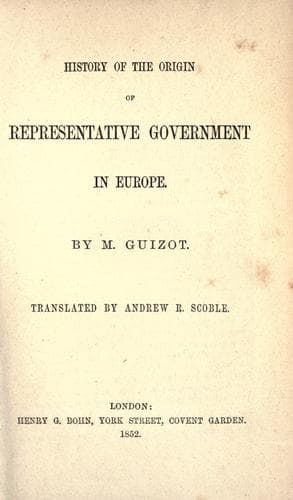
History of the Origin of Representative Government in EuropeGuizot, François
History
History of the Origin of Representative Government in Europe
Guizot, François
Europe -- History; Representative government and representation
When we have mentioned the allodial proprietors and the
beneficiaries, it might be thought that the class of freemen is
exhausted. Such is not, however, the case. There were different
classes of possessors and farmers of tributary lands, known under
various names; such as _fiscalini, fiscales, tributarii,
coloni, lidi, aldi, aldiones,_ &c. These names do not all
designate different conditions, but divers shades in conditions
substantially the same. There were: _First_, free men, at
once allodial proprietors and cultivators; _Secondly_, free
men, both proprietors of benefices and cultivators;
_Thirdly_, free men, neither properly freeholders nor
beneficiaries, and cultivators; _Fourthly_, men not free, to
whom the hereditary possession of tributary land had been granted
on the payment of certain fees and services; _Fifthly_, men
not free, who only enjoyed the permanent occupancy of tributary
land. Here again we cannot find any general and fixed social
condition which shall determine what were the rank, the rights,
and other qualifications of the individuals belonging to it. We
are mistaken if we imagine either that every proprietor was free,
or that every free man was a proprietor. We find that the
cultivators of lands under the king harassed and oppressed the
smaller allodial proprietors who resided in their vicinity, and
were too feeble to oppose any effectual resistance, although they
were Franks.
{137}
I need only mention slaves, in order to observe that many free
men fell into this state of servitude by means of violence, and
through an uncertainty in property which involved a corresponding
uncertainty in position. Sometimes one man would surrender
himself to his more powerful neighbour, and at the same time
completely abandon his liberty. The surrender, however, was
sometimes not an entire renouncement of liberty, although it was
alienated for life, or a sum was agreed upon to be paid if the
engagement should be broken.
Test Of Social Conditions.
It is evident that we cannot derive, from the state and the
distribution of territorial properties, any true and fixed table
of different social conditions, and of the importance of the
rights belonging to each. These conditions were too undefined,
too different, while nominally identical, and too fluctuating, to
give us a standard to measure the amount of liberty possessed by
each man and the place he occupied in society. The state of
persons was almost individual; the measure of the importance of
any individual was determined by the particular amount of
strength which might belong to him, much more than by the general
position which he apparently occupied. Individuals constantly
passed from one condition into another, neither losing all at
once every characteristic of the position which they left, nor
assuming at once every characteristic of that upon which they
newly entered.
Let us apply another principle.
The Wehrgeld
Public-domain text, read in full here on John Shaqi.
Reviews
Reviews
No reviews yet
Be the first to share your thoughts on this work.
Elsewhere in the archive
Join the Discussion
Join the discussion
Sign in to leave a comment or review.
Sign InorCreate an account