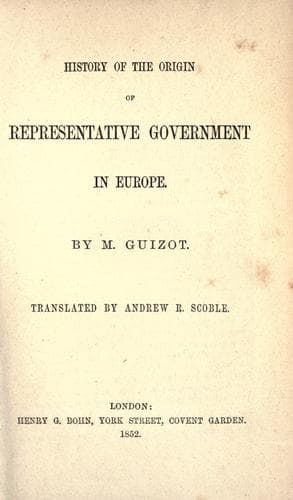
History of the Origin of Representative Government in EuropeGuizot, François
History
History of the Origin of Representative Government in Europe
Guizot, François
Europe -- History; Representative government and representation
Large allodial proprietors were sometimes able to remain for a
considerable time in such a position. But it was not certainly
the strongest, nor consequently the most free and fixed
condition; for we have seen that allodial property degenerated
and declined, until almost all the allodial proprietors became
beneficiaries. We have seen how the anger of Etichon was excited.
The general fact is a witness against the life of the allodial
proprietor. His very independence was a cause of isolation, and
therefore of feebleness. The proprietors of allods, wearied with
living on their estates, shut out from all society, used to come
and live with the king or some large proprietor of greater power
than themselves. It was soon a practice to send their children
thither, in order that they might become companions of the
prince, or of some distinguished noble.
As to the smaller allodial proprietors, they could not keep their
standing long; they were not strong enough to defend their
independence. The records of the period show that their property
was soon alienated, and at the same time many of them became
merely cultivators of the lands. The condition of the freeholder
thus became merged in that of the tributary. From thence there
was but one step to a total loss of liberty. This step was
actually taken by a large number of allodial proprietors--wearied
out or ruined, they surrendered their liberty into the hands of
proprietors more wealthy and powerful than themselves.
We come now to the beneficiaries.
Benefices originated large individual resources;--in them we find
the source of the feudal aristocracy;--large beneficiaries became
in time powerful nobles. But we must not from this conclude that
the possession of benefices was, during the period we are
considering, any security for a permanent social position, to
which power and liberty necessarily belonged. _First_, this
possession was precarious, moveable, attacked, in the case of the
smaller beneficiaries, by the larger ones, and in the case of the
latter by the king.
{136}
Beneficiary property hardly began to possess any fixity at the
close of the ninth century. _Secondly_, a number of small
benefices were conferred on individuals too weak efficiently to
defend their position and their liberty. In order to secure the
services of a man who was not a slave, a benefice was given to
him--it was therefore a grant for the support of a retainer. The
land itself was given for this purpose, as well as its
productions. The benefices given to Charlemagne's stewards and
the keepers of his horse were actual benefices, and not, as M. de
Montlosier thinks, tributary lands. We are not then in a position
to say that the rank of a beneficiary was the sign of a
definitely marked social position, nor that it could measure the
degree of importance and of freedom that belonged to individuals.
Various Classes Of Free Men.
Public-domain text, read in full here on John Shaqi.
Reviews
Reviews
No reviews yet
Be the first to share your thoughts on this work.
Elsewhere in the archive
Join the Discussion
Join the discussion
Sign in to leave a comment or review.
Sign InorCreate an account