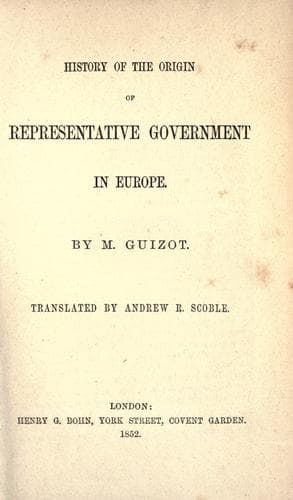
History of the Origin of Representative Government in EuropeGuizot, François
History
History of the Origin of Representative Government in Europe
Guizot, François
Europe -- History; Representative government and representation
During a considerable period the hereditariness of these officers
was not recognised. Some antiquaries even are of opinion that
these employments were given for a fixed time only. There is more
reason to believe that this point was not definitely determined,
and that, in fact, these offices were long unlimited as to their
duration, and always transferable; numerous instances can be
brought in support of this theory. The Frankish kings frequently
allowed the natural chieftains of the countries which they
conquered to retain their former position and ancient rights.
Thus the Bavarian dukes were hereditary. When Louis the Debonnair
received the Spaniards into the south of France, he permitted
their counts to retain their titles and jurisdiction.
Dukes And Counts.
The title of count become an object of ambition on account of the
advantages connected therewith. The count possessed great power,
a share of the fines, _freda_, and immense facilities for
acquiring property in the district under his jurisdiction. These
offices also supplied the kings with means for enriching their
Leudes, or obtaining new ones. Under the Merovingians, perpetual
instability prevailed in respect to these offices as well as to
benefices; they were obtained by presents or purchased by money.
Nevertheless, the office of count was frequently transmitted from
father to son; this was natural, and usage could not fail to
precede right; the count or duke, being almost always an
important personage in his canton or town, independently of his
office, his son, who succeeded to his importance, succeeded
frequently to his office also.
Some writers have affirmed that there was a great distinction
between the dukes and the counts; it has even been asserted that
each duke had twelve counts under his orders. No such regularity
existed in local administration. We meet with some counts equal
in power to dukes; among the Burgundians, for example, some
counts ruled over several provinces. We may say, however, that in
general the duke was superior to the count. We may even presume
that, originally, the office of duke was military, and that of
the count, judicial; although the two missions frequently appear
confounded. A formula of Marculf assimilates the dukes, counts,
and patricians. The margraves were the counts of the marches or
frontiers. The men of the court, the delegates of the king,
finished by being counts everywhere.
{153}
Thus there co-existed the three systems of institutions which I
have mentioned: 1. the assemblies of freemen, having authority
and jurisdiction; 2. the great landowners, whether beneficiary or
allodial, lay or ecclesiastical, proprietors--having authority
and jurisdiction; 3. the administrators or delegates of the king,
having authority and jurisdiction.
Extension Of Seignorial Jurisdiction.
Public-domain text, read in full here on John Shaqi.
Reviews
Reviews
No reviews yet
Be the first to share your thoughts on this work.
Elsewhere in the archive
Join the Discussion
Join the discussion
Sign in to leave a comment or review.
Sign InorCreate an account