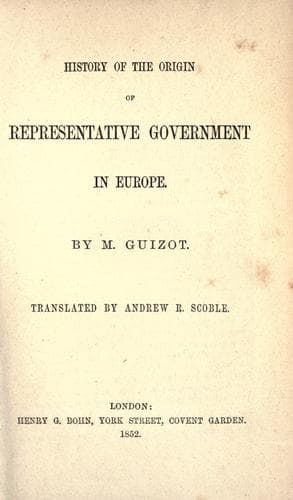
History of the Origin of Representative Government in EuropeGuizot, François
History
History of the Origin of Representative Government in Europe
Guizot, François
Europe -- History; Representative government and representation
In the midst of the disorders of the Merovingian race, we find
that the assemblies of free men rapidly declined. Most of the
free men ceased to attend. Some became powerful enough to aim at
independence, others became so weak as to lose their freedom. The
common deliberation of free men disappeared. The principle of the
subordination of the individual to the individual, in virtue of
protection, vassalage, patronage, or colonage, prevailed.
Seignorial jurisdictions, both lay and ecclesiastical, became
extended. Their extension and consolidation were the necessary
consequence of the extension and consolidation of benefices. The
diminution of the number of allodial estates, the increase of
tributary lands, and the corresponding changes which were
introduced into the condition of persons, necessarily removed the
greater number of justiceables from the jurisdiction of the
assemblies of free men and from that of the king. Even the care
which was taken by the first Carlovingians to compel the
seigneurs to administer justice, and to control their
administration of it, proves the progress of this kind of
jurisdiction.
The liberty allowed to every man to live under any law he
pleased, could not but contribute also to this result; it tended
to disperse society, for it placed men under the jurisdiction of
those who had their own private code of laws; and thus it opposed
union, and common deliberation. It was a kind of liberty,
doubtless--a liberty necessary in the state of society which then
existed; but this liberty, like almost all other liberties at
this period, was a principle of isolation.
{154}
Lecture XIX.
Government of Charlemagne.
Apparent revival of free institutions.
Individual independence and social liberty.
Organization of monarchical power under Charlemagne.
His active surveillance over his vassals and agents.
Rapid decline of monarchical institutions after his death.
Definitive predominance of the feudal system.
Central institutions during the same epoch: royalty.
Causes of the progress of royalty, and of the principle of
hereditary succession among the Franks.
Influence of the clergy.
Two Meanings Of Personal Liberty.
After the Merovingian anarchy, at the accession of the
Carlovingians and especially during the reign of Charlemagne, two
facts, which seem contradictory, present themselves to our
notice. Free institutions appear to gain new life, and at the
same time the monarchical system evidently prevails. We must
closely study this singular coincidence, and endeavour thoroughly
to understand its causes.
There are two ways in which we may understand a man's personal
liberty; first, as the independence of the individual having no
law but his own will; and secondly, as the enfranchisement of
every individual from every other individual will, which is
contrary to reason and justice.
Public-domain text, read in full here on John Shaqi.
Reviews
Reviews
No reviews yet
Be the first to share your thoughts on this work.
Elsewhere in the archive
Join the Discussion
Join the discussion
Sign in to leave a comment or review.
Sign InorCreate an account