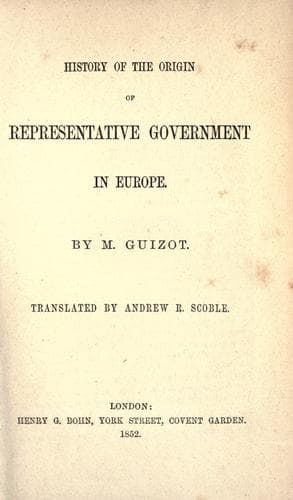
History of the Origin of Representative Government in EuropeGuizot, François
History
History of the Origin of Representative Government in Europe
Guizot, François
Europe -- History; Representative government and representation
It is by these means that great men triumph at first. It was thus
that Charlemagne triumphed; it was thus that the first three
Carlovingians, Pepin of Heristal, Charles Martel, and Pepin the
Short, had prepared the way for him. Under the Merovingians, the
state was falling into dissolution; every strong man was making
himself independent, every weak man was falling into subjection
to a stronger. Although the Pepins had sprung from the dominant
aristocracy, they early struggled against its excesses. Charles
Martel put down the petty tyrants who had sprung up in every
direction. The tendency of Charlemagne's policy was to establish
the monarchical system, that is, to secure the universal
prevalence of his will by making it felt everywhere by means of
his agents. In order to understand with any exactness what was
Charlemagne's pure monarchy, we must see how he managed his own
property, and in what manner he administered his palace. The
activity of his surveillance was surprising; we shall find
details of it in his capitulary _De villis_, and in the
first part of one of Hincmar's letters. He governed his empire in
the same spirit. This was the only means he possessed for
restoring order, and applying the national forces to the
accomplishment of his designs. Into the despotism of a superior
man, there always enters a powerful instinctive feeling of
justice, and of protection to the weak. Charlemagne diligently
endeavoured to check the power of the nobles by subjecting them
to surveillance, and by bringing his subjects into direct
relationship with the royal authority. He paid great attention to
the employment and administration of his benefices, even when in
the hands of beneficiaries; he was careful not to give more than
one county to the same count, and this rule he rarely
transgressed; he ordered the nobles to distribute strict justice
to their vassals, and took most energetic measures to compel them
to do so, and to judge all men according to the law. Charlemagne
also kept watch over the conduct of the counts; the assemblies of
free men had almost entirely perished; and they requested as a
favour to be allowed to absent themselves. To supply the place of
the active surveillance exercised by these ancient assemblies,
Charlemagne created the _missi dominici_. These were
inspectors of the whole state of the kingdom, and particularly of
the conduct of the counts and nobles.
{158}
Decline Of The Frankish Monarchy.
The delegates of Charlemagne, the imperial judges, had assessors;
and as the free men whose duty it was to fill the office of
assessors seldom attended the periodical assemblies, Charlemagne
superseded them by the _scabini_, who were appointed by the
_missi dominici_, whom he enjoined to select them with the
greatest care. This intervention of the delegates of the
sovereign himself in judicial affairs, was a powerful means of
monarchical centralization.
Public-domain text, read in full here on John Shaqi.
Reviews
Reviews
No reviews yet
Be the first to share your thoughts on this work.
Elsewhere in the archive
Join the Discussion
Join the discussion
Sign in to leave a comment or review.
Sign InorCreate an account