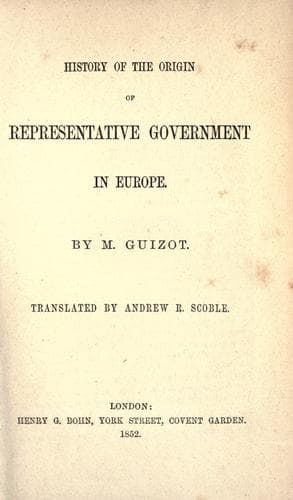
History of the Origin of Representative Government in EuropeGuizot, François
History
History of the Origin of Representative Government in Europe
Guizot, François
Europe -- History; Representative government and representation
In his Frankish empire, it was not against the ancient free
institutions, but against public anarchy and the disorderly power
of the strong, that Charlemagne directed these means of
government. In his other dominions, wherever he feared the
influence of liberty, his despotism was exerted to crush it
rigorously; thus he interdicted all public assemblies of the
Saxons.
All this monarchical organization fell with Charlemagne. Its
existence is protracted, as if by habit, in the speeches and laws
of Louis the Debonnair; but the hand which sustained the edifice
is no longer there. The language of Charlemagne in the mouth of
Charles the Bald, is nothing but a piece of ridiculous
rhodomontade. The feudal system gains the upper hand and
organizes itself in every direction. The great vassals either
attack the king or isolate themselves from him. The dignity of
count became so considerable, that the sons of kings and emperors
desire and obtain it. Hereditary succession prevails in the
offices of dukes, counts, viscounts, &c. Rhegino cites as a
singular fact that the sons of Duke Robert did not succeed to his
dukedom, and assigns as the reason, that their tender age
rendered them incapable of repulsing the Normans. The sons of two
counts of Austria were not put into possession of the counties of
their fathers; so their relations took arms, and drove out the
usurper. The power of the counts, now they had become hereditary
seigneurs, was augmented by the authority they had exercised,
under that title, as delegates of the king. The feudal hierarchy,
strong by its own intrinsic power, thus gained additional
strength from the wreck of royal authority. Hence resulted a new
order of local institutions, which I cannot now explain.
{159}
The picture of central institutions reproduces, under another
aspect, the same facts, and leads to the same results. Central
institutions, as you are aware, may be reduced to two--royalty,
and the general assemblies of the nation.
Royalty Among The Franks.
To royalty among the Franks you may apply what I have said of
royalty among the Anglo-Saxons; only, among the Franks, the royal
family does not bear, at the outset, the character of a religious
filiation. This is perhaps attributable to the fact that the
Franks were a confederation of different tribes; among them, the
king appears especially as a military chieftain. Under the first
Merovingians, there was always a great mixture of hereditariness
and election; hereditariness fluctuated among the members of the
same family; election, when it was not an act of violence, was
rather a recognition than an election.
Public-domain text, read in full here on John Shaqi.
Reviews
Reviews
No reviews yet
Be the first to share your thoughts on this work.
Elsewhere in the archive
Join the Discussion
Join the discussion
Sign in to leave a comment or review.
Sign InorCreate an account