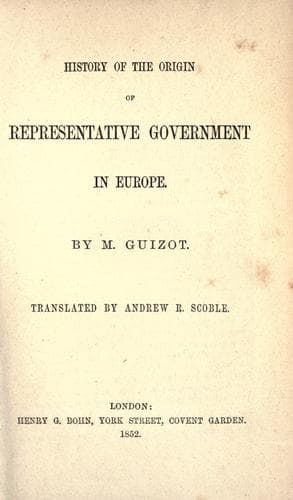
History of the Origin of Representative Government in EuropeGuizot, François
History
History of the Origin of Representative Government in Europe
Guizot, François
Europe -- History; Representative government and representation
The feudal system brought the master into close connection with
the subject, and the sovereign with those who depended upon him;
in this sense it was a cause of oppression and servitude. It is
difficult to escape from a power that is ever near, and almost
present. The human will is subject to strange caprices, and never
is this more frequently exemplified than when the objects on
which it acts are in its power. You may breathe a little under an
arbitrary power, if it be very lofty and very distant; but if it
be at your elbow, you are truly a slave. Local tyranny is the
worst of all; though difficult to avoid, it can easily defend
itself. A handful of men have often kept the population of a
large town in servitude for ages. The citizens, colonists, and
serfs felt themselves so grievously oppressed by the feudal lords
that they preferred to their absolute power the absolute power of
the kings, even with more extensive and irresistible rights than
those possessed by the lords. A certain and general despotism has
neither the same interest in being tyrannical, nor the same means
of oppression. This will explain the intensity of feudal
oppression, and the profound hatred which it inspired.
{175}
Influence Of Feudalism.
The feudal system placed the inferior near his superior; and, in
this sense, it was a principle of dignity and liberty. Many
vassals were equal in rank to each other, and on terms of
familiarity; frequently the inequality between the superior and
inferior was not great, so that the latter was neither humiliated
thereby, nor obliged to play the courtier. Protection was a
right; the suzerain had absolute need of his vassals. There was
no room, in their relations to one another, for servility and
baseness of soul. Moreover, the vassals had reasons and means for
banding together to defend themselves against oppression; they
possessed common rights and interests. The intimacy in which they
lived with their lord prevented the feeling of their mutual
rights from becoming effaced within them; thus feudal relations
are generally full of dignity and high-spiritedness; a noble
sentiment, fidelity instead of submission, guides their conduct.
Now, wherever a profound moral sentiment exists, it must
necessarily call others into action; hence the many splendid and
honourable developments of human nature under the feudal system:
these developments were concentrated, it is true, within the
circle of the lords and vassals; but even that is better than the
equal abasement of all under an universal despotism.
Thus, whilst feudalism disregarded and insulted both justice and
the dignity of man among the masses whom it claimed as subjects,
it respected and developed both among its own hierarchy. In this
hierarchy, liberty existed, with all its accompaniments. Below
were servitude and its attendant evils, with all the shames that
follow in their train.
Absence Of The Representative System.
Public-domain text, read in full here on John Shaqi.
Reviews
Reviews
No reviews yet
Be the first to share your thoughts on this work.
Elsewhere in the archive
Join the Discussion
Join the discussion
Sign in to leave a comment or review.
Sign InorCreate an account