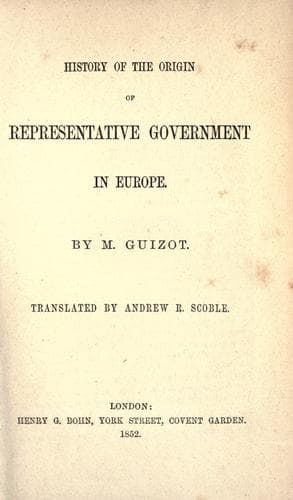
History of the Origin of Representative Government in EuropeGuizot, François
History
History of the Origin of Representative Government in Europe
Guizot, François
Europe -- History; Representative government and representation
I may now fearlessly affirm that, in the institutions of the
period from the fifth to the tenth century, there is no trace of
the representative system. We pass from the independence of
individuals, sometimes to the power of the king, sometimes to the
predominance of the great landowners. But there is no political
organization founded upon ideas of general law and public
interest; all institutions have reference to private rights and
interests. Two opposite forces are in conflict; there is nothing
to reveal the division of powers, and their tendency towards one
common object.
{176}
There are no representatives of the rights of all; none elected
in the name of the interests of all; those who have rights
exercise them personally; those who do not exercise them
personally do not possess them. The ecclesiastics alone preserve
the idea of the general right of all men to justice and to good
government; but this idea is not transfused into any
institutions. Neither the philosophic principle, nor any of the
true external characteristics of representative government, can
anywhere be met with.
{177}
Lecture XXII.
Political institutions of the Visigoths.
Peculiar character of Visigothic legislation.
Its authors and its influences.
Destruction and disappearance of the middle class in the Roman
empire, at the time of the Barbarian invasion.
History of the Roman municipal system.
Three epochs in that history.
Laws Of The Visigoths.
In conformity to the plan which I sketched out for our guidance
at the commencement of these lectures, I have studied with you
the political institutions of the Anglo-Saxons and Franks, from
the fifth to the tenth century. I now come to those of the
Visigoths, the third of the Barbarian peoples established in the
Roman empire, about whom I propose to give you some information.
On opening the collection of the laws of the Visigoths, it is
impossible not to be struck with the compactness which
distinguishes them. The Franks and Burgundians have laws
partially anterior to their establishment upon the Roman
territory; customs handed down and gathered together from age to
age. The Visigoths have a code which was systematically drawn up,
and promulgated on an appointed day.
This fact alone indicates that the laws of the Visigoths were not
the work of the Barbarians themselves. The influence of the
clergy, indeed, was more potent among the Visigoths than among
the other Barbarian conquerors; not only did the clergy take part
in their government, but they acted as their civil and political
legislators. The Visigothic code was their work. How did this
happen?
Public-domain text, read in full here on John Shaqi.
Reviews
Reviews
No reviews yet
Be the first to share your thoughts on this work.
Elsewhere in the archive
Join the Discussion
Join the discussion
Sign in to leave a comment or review.
Sign InorCreate an account