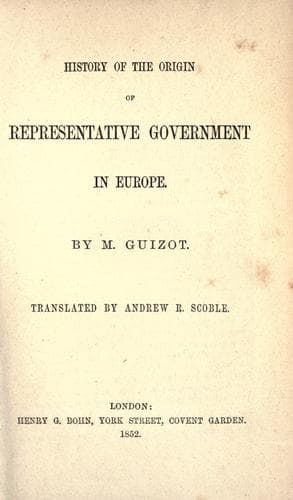
History of the Origin of Representative Government in EuropeGuizot, François
History
History of the Origin of Representative Government in Europe
Guizot, François
Europe -- History; Representative government and representation
4. Although the judicial power had been withdrawn from the
localities, we nevertheless meet with some traces of a
Jurisdiction somewhat similar to that which we call municipal
police, giving judgment upon offences against the laws, with
regard to public health, weights and measures, markets, and so
forth.
Municipal Officers.
All these local affairs were managed either by magistrates
appointed by the inhabitants, or by the _curia_ of the town
or _college of decurions_, that is, of all the inhabitants
who possessed a fixed landed income. In general, the _curia_
appointed the magistrates; we meet with some instances, however,
of their being appointed by the general body of the inhabitants.
But at this period, and by a necessary consequence of the
existence of slavery, there were few free men who did not belong
to the _curia_.
The origin of the word _decurio_ is uncertain. Some writers
are of opinion that he was an officer placed at the head of ten
families, like the _tything-man_, or _tunginus_ of the
German peoples. Others think that _decurio_ simply means
member of a _curia_. The last interpretation seems to me the
more probable of the two. At a later period, the decurions were
called _curiales_.
{184}
Constitution Of The Municipia.
Such was the constitution of the _municipia_ at the end of
the Roman republic. It presents, as results, the following
general facts:
1. All political rights and interests, all political life, in
short, was centralized at Rome, not merely morally and by law,
but materially and in fact. Within the walls of Rome alone
could be consummated all the acts of a Roman citizen.
2. No centralization of this kind had taken place in reference
to what we now call administrative interests. Each town had
remained isolated and distinct in this respect, regulating its
own affairs, just as a private individual would do.
3. The appointment and surveillance of the magistrates who
administered the local affairs of the town took place on the
spot, without any intervention of the central power, and by the
assembly of the principal inhabitants.
4. Into this assembly were admitted all the inhabitants who
possessed a certain income. There is reason to believe that a
few free men only were excluded therefrom.
Here begins a second epoch in the history of the Roman municipal
system.
The absolute separation of political from local existence, and
the impossibility of exercising political rights elsewhere than
in Rome, could not fail to deprive the towns of their principal
citizens, and also of a great part of their importance. Thus,
during the epoch which we have just surveyed, purely local
interests occupied only a small place. Rome absorbed everything.
The independence left to other towns, as regarded matters that
were not treated of at Rome, or did not emanate from Rome, arose
from the slight importance of those matters.
Public-domain text, read in full here on John Shaqi.
Reviews
Reviews
No reviews yet
Be the first to share your thoughts on this work.
Elsewhere in the archive
Join the Discussion
Join the discussion
Sign in to leave a comment or review.
Sign InorCreate an account