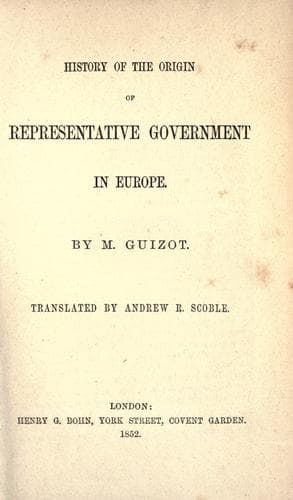
History of the Origin of Representative Government in EuropeGuizot, François
History
History of the Origin of Representative Government in Europe
Guizot, François
Europe -- History; Representative government and representation
4. The heirs of curials, when not members of the _curia_,
and the widows or daughters of curials, who married men
belonging to other classes, were bound to give a fourth part of
their goods to the _curia_.
5. The curials who had no children could not dispose, by will,
of more than a fourth of their property: the other
three-fourths went, by right, to the curia.
6. They were not allowed to absent themselves from their
_municipium_, even for a limited time, without permission
from the judge of the province.
7. When they had withdrawn from their _curia_, and could
not be brought back, their property was confiscated to the
benefit of their _curia_.
8. The tax known by the name of _aurum coronarium_, and
which consisted in a sum to be paid to the prince, on the
occasion of certain events, was levied on the curials alone.
Advantages Granted To The Curials.
The only advantages granted to the curials in compensation
for these burdens were:
1. Exemption from torture, except in very serious cases.
2. Exemption from certain afflictive and dishonouring
punishments which were reserved for the populace; such as being
condemned to work in the mines, to be burned alive, and so
forth.
3. Decurions who had fallen into indigence were supported at
the expense of the _municipium_.
These were the only advantages possessed by the curials over the
common people, who, on the other hand, enjoyed the benefit that
every career was open to them, and that, by entering the army, or
engaging in public employments, they might raise themselves at
once into the privileged class.
The condition of the curials, then, both as citizens and in
relation to the State, was onerous and devoid of liberty.
Municipal administration was a burdensome service, to which the
curials were doomed, and not a right with which they were
invested. Let us now see what was the condition of the curials,
not in relation to the State, and to the other classes of
citizens, but in the _curia_ and amongst themselves. Here
still existed the forms, and even the principles, of liberty. All
the curials were members of the _curia_, and sat therein.
The ability to bear the burdens of the office entailed that of
exercising its rights, and taking part in its affairs; the names
of all the curials of each _municipium_ were inscribed, in
an order which was determined according to their dignity, age,
and other circumstances, in a book called the _album curiæ_.
{197}
When there was occasion to deliberate upon any matter, they were
all convoked together by the superior magistrate of the town, the
_duumvir, ædilis_ or _prætor_, and they all gave their
opinions and their votes; everything was decided by the majority
of votes: and no deliberation of the _curia_ was valid
unless two-thirds of the curials were present.
Attributes Of The Curia.
The attributes of the curia as a body were:
1. The examination and decision of certain affairs;
Public-domain text, read in full here on John Shaqi.
Reviews
Reviews
No reviews yet
Be the first to share your thoughts on this work.
Elsewhere in the archive
Join the Discussion
Join the discussion
Sign in to leave a comment or review.
Sign InorCreate an account