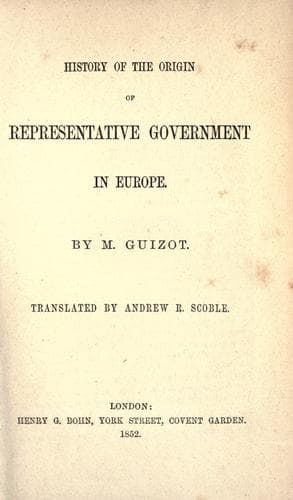
History of the Origin of Representative Government in EuropeGuizot, François
History
History of the Origin of Representative Government in Europe
Guizot, François
Europe -- History; Representative government and representation
2. The appointment of magistrates and municipal officers.
Nowhere can I find an enumeration of the affairs which fell under
the cognizance of the _curia_ as a body. Everything,
however, indicates that most of those municipal interests which
required more than the simple execution of the laws or of orders
already given, were discussed in the _curia_. The proper and
independent authority of the municipal magistrates appears to
have been very limited. For example, there is reason to believe
that no expense could be incurred without the authorization of
the _curia_. It fixed the time and place for holding fairs;
it alone granted recompenses; and so forth.
There were even occasions on which the authorization of the
_curia_ was not sufficient, and when it was necessary to
have the sanction of all the inhabitants, whether curials or not;
for example, for the sale of any property belonging to the
commune, or for the despatch of deputies to wait on the emperor
in reference to any grievance or request. On the other hand, it
is evident that, by the general progress of despotism, the
imperial power continued daily to interfere more and more in the
affairs of the _municipia_, and to limit the independence of
the _curiæ_. Thus they might not erect new buildings without
the permission of the governor of the province; the reparation of
the walls around the towns was subject to the same formality; and
it was also necessary for the emancipation of slaves, and for all
acts which tended to diminish the patrimony of the city. By
degrees, also, even those affairs the final decision of which had
previously belonged to the _curiæ_ fell, by way of objection
or appeal, under the authority of the emperor and his delegates
in the provinces. This occurred in consequence of the absolute
concentration of judicial and fiscal power in the hands of the
imperial functionaries. The _curia_ and the curials were
then reduced to be nothing more than the lowest agents of the
sovereign authority. There was left to them hardly anything
beyond the right of consultation and the right of complaint.
{198}
Municipal Offices.
With regard to the appointment to municipal magistracies, it
remained for a long time, in reality, in the hands of the
_curia_, without any necessity for its confirmation by the
governor of the province, except in exceptional cases of towns
which it was specially intended to ill-use or punish. But even
this right soon became illusory by reason of the power given to
provincial governors to annul the appointment on the demand of
the person elected, When municipal functions had become merely
burdensome, all the curials elected to discharge these offices,
who had any influence with the governor, were able, under some
pretext or another, to get their election annulled, and thus to
escape from the load.
Public-domain text, read in full here on John Shaqi.
Reviews
Reviews
No reviews yet
Be the first to share your thoughts on this work.
Elsewhere in the archive
Join the Discussion
Join the discussion
Sign in to leave a comment or review.
Sign InorCreate an account