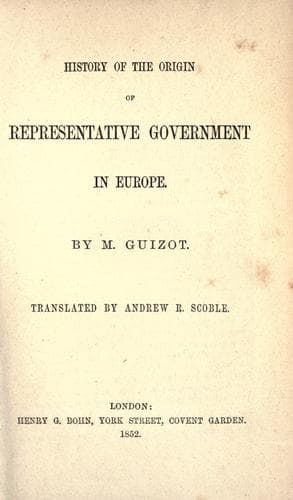
History of the Origin of Representative Government in EuropeGuizot, François
History
History of the Origin of Representative Government in Europe
Guizot, François
Europe -- History; Representative government and representation
1. Every inhabitant possessing a fortune which guaranteed his
independence and intelligence, was a curial; and, as such,
called upon to take part in the administration of the affairs
of the city. Thus, the right was attached to presumed capacity,
without any privilege of birth, or any limit as to number; and
this right was not a simple right of election, but the right of
full deliberation, of immediate participation in affairs, as
far as they related to what occurred in the interior of a town,
and to interests which might be understood and discussed by all
those who were capable of raising themselves above the cares of
individual existence. The _curia_ was not a restricted and
select council, it was an assembly of all the inhabitants who
possessed the conditions of curial capacity.
2. An assembly cannot administrate--magistrates are necessary.
These were all elected by the _curia_, for a very short
time; and they answered for their administration by their
private fortune.
3. In circumstances of importance, such as changing the
condition of a city, or electing a magistrate invested with
vague and more arbitrary authority, the _curia_ itself was
not sufficient; the whole body of the inhabitants was called in
to take part in these solemn acts.
Who, on beholding such rights, would not think that he saw a
small republic, in which municipal and political life were merged
in one another, and in which the most democratic rule prevailed?
Who would think that a municipality thus regulated formed a part
of a great empire, and depended, by narrow and necessary bonds,
on a remote and sovereign central power?
{204}
Who would not, on the contrary, expect to meet with all the
outbreaks of liberty, all the agitations and cabals, and
frequently all the disorder and violence which, at all periods,
characterize small societies thus shut up and governed within
their own walls?
Principles Of Despotism.
Nothing of the kind was the case, and all these principles of
liberty were lifeless. Other principles existed which struck them
to death.
Public-domain text, read in full here on John Shaqi.
Reviews
Reviews
No reviews yet
Be the first to share your thoughts on this work.
Elsewhere in the archive
Join the Discussion
Join the discussion
Sign in to leave a comment or review.
Sign InorCreate an account