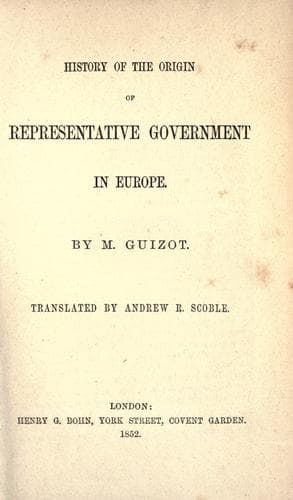
History of the Origin of Representative Government in EuropeGuizot, François
History
History of the Origin of Representative Government in Europe
Guizot, François
Europe -- History; Representative government and representation
1. Such were the effects and exactions of the central despotism
that the quality of curial ceased to be a right confessedly
belonging to all who were capable of exercising it, and became
a burden imposed upon all who were able to bear it. On the one
hand, the government discharged itself from the care of
providing for those public services which did not affect its
own interests, and so cast the obligation on this class of
citizens; and, on the other hand, it employed them to collect
the taxes destined for its use, and made them responsible for
the payment thereof. It ruined the curials in order to pay its
own functionaries and soldiers; and it granted to its own
functionaries and soldiers all the advantages of privilege, in
order to obtain their assistance forcibly to prevent the
curials from escaping from their impending ruin. Complete
nullities as citizens, the curials lived only to be fleeced.
2. All the elective magistrates were, in fact, merely the
gratuitous agents of despotism, for whose benefit they robbed
their fellow-citizens, until they should be able, in some way
or another, to free themselves from this unpleasant obligation.
3. Their election even was valueless, for the imperial delegate
in the province could annul it, and they had the greatest
personal interest in obtaining this favour from him; in this
way also, they were at his mercy.
4. Lastly, their authority was not real, for it had no
sanction. No effective jurisdiction was allowed them; they
could do nothing that might not be annulled. Nay, more: as
despotism daily perceived more clearly their impotence or
ill-will, it daily encroached further upon the domain of their
attributes, either by its own personal action, or by its direct
delegates. The business of the _curia_ vanished
successively with its powers; and a day was not far distant
when the municipal system would be abolished at a single stroke
in the rapidly decaying empire, "because," the legislator would
say, "all these laws wander, in some sort, vaguely and
objectless about the legal territory."
{205}
General Conclusions.
Public-domain text, read in full here on John Shaqi.
Reviews
Reviews
No reviews yet
Be the first to share your thoughts on this work.
Elsewhere in the archive
Join the Discussion
Join the discussion
Sign in to leave a comment or review.
Sign InorCreate an account