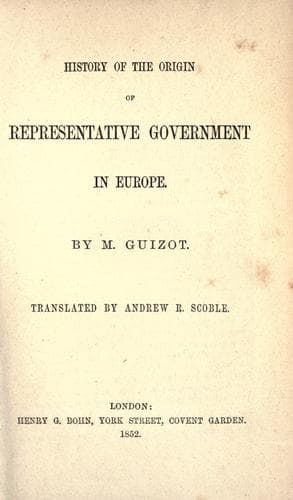
History of the Origin of Representative Government in EuropeGuizot, François
History
History of the Origin of Representative Government in Europe
Guizot, François
Europe -- History; Representative government and representation
Thus, the municipal power, having become completely estranged
from political and civil power, ceased to be a power itself.
Thus, the principles and forms of liberty, isolated remains of
the independent existence of that multitude of towns which were
successively added to the Roman empire, were impotent to defend
themselves against the coalition of despotism and privilege.
Thus, here also, we may learn what so many examples teach us;
namely, that all the appearances of liberty, all the external
acts which seem to attest its presence, may exist where liberty
is not, and that it does not really exist unless those who
possess it exercise a real power--a power, the exercise of which
is connected with that of all powers. In the social state,
liberty is participation in power; this participation is its
true, or rather its only, guarantee. Where liberties are not
rights, and where rights are not powers, neither rights nor
liberties exist.
We must not, therefore, be surprised either at that complete
disappearance of the nation which characterized the fall of the
Roman empire, or at the influence which the clergy soon obtained
in the new order of things. Both phenomena are explained by the
state of society at that period, and particularly by that state
of the municipal system which I have just described. The bishop
had become, in every town, the natural chief of the inhabitants,
the true mayor. His election, and the part which the citizens
took in it, became the important business of the city. It is to
the clergy that we owe the partial preservation, in the towns, of
the Roman laws and customs, which were incorporated at a later
period into the legislation of the State. Between the old
municipal system of the Romans, and the civil-municipal system of
the communes of the Middle Ages, the ecclesiastical municipal
system occurred as a transition. This transition state lasted for
several centuries. This important fact was nowhere so clearly and
strongly developed as in the monarchy of the Visigoths in Spain.
{206}
Lecture XXIV.
Sketch of the history of Spain under the Visigoths.
Condition of Spain under the Roman empire.
Settlement of the Visigoths in the south-west of Gaul.
Euric's collection of the laws of the Visigoths.
Alaric's collection of the laws of the Roman subjects.
Settlement of the Visigoths in Spain.
Conflict between the Catholics and Arians.
Political importance of the Councils of Toledo.
Principal kings of the Visigoths.
Egica collects the _Forum judicum_.
Fall of the Visigothic monarchy in Spain.
Spain Under The Roman Empire.
Public-domain text, read in full here on John Shaqi.
Reviews
Reviews
No reviews yet
Be the first to share your thoughts on this work.
Elsewhere in the archive
Join the Discussion
Join the discussion
Sign in to leave a comment or review.
Sign InorCreate an account