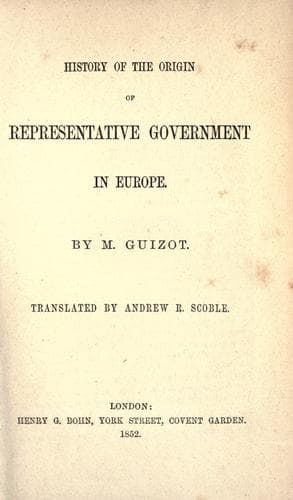
History of the Origin of Representative Government in EuropeGuizot, François
History
History of the Origin of Representative Government in Europe
Guizot, François
Europe -- History; Representative government and representation
5. Euric (466-484). This reign was the culminating point of the
Visigothic monarchy in Gaul. Euric led expeditions beyond the
Loire against the Armoricans; in 474, he conquered Auvergne,
which was then ceded to him by treaty; he had already conquered
Arles and Marseilles, so that the monarchy of the Visigoths
then extended from the Pyrenees to the Loire, and from the
Ocean to the Alps, thus adjoining the monarchies of the
Burgundians and Ostrogoths. Euric had also extended his
dominions into Spain, where he possessed the Tarragonese
district and Bœtica, which he had conquered from the Suevi.
Euric had the laws and customs of the Goths written in a book.
A passage of Sidonius Apollinarius which speaks of
_Theodoricianæ leges_, has led to the belief that
Theodoric commenced this collection; but Euric is also called
Theodoric.
6. Alaric II. (484-507.) This reign was the epoch of the decay
of the Visigothic monarchy in Gaul. Alaric, less warlike than
his predecessors, gave himself up to the pursuit of pleasure.
He was defeated by Clovis, at Vouillé near Poitiers, and left
dead on the field. The Franks in the east, and the Burgundians
in the west, dismembered the Visigothic monarchy, which thus
became reduced to Languedoc, properly so called, and a few
districts adjacent to the Pyrenees.
{209}
The Breviarium Aniani.
Alaric did for his Roman subjects what Euric had done for the
Goths. He collected and revised the Roman laws, and formed them
into a code called the _Codex Alaricianus_. This code was
based upon the _Codex Theodosianus_ published in 438 by
Theodosius the Younger, and upon the _Codex Gregorianus_,
the _Codex Hermogenianus_, the _Pauli Sententiæ_, and
the _Constitutiones Imperiales_, published subsequently to
the reign of Theodosius. This code was also called the
_Breviarium Aniani_. It has been thought that Anianus, the
referendary of Alaric, was its principal editor; but Père Sirmond
has proved that Anianus only published it by order of the king,
and sent authentic copies of it into the provinces. By an act
of Alaric, the Roman legislation was, so to speak, revived,
rearranged, and adapted to the monarchy of the Goths. It
thenceforth emanated from the Gothic king himself. In the north
of Gaul, whilst the Barbarian laws ceased to be customs and
became written laws, the Roman laws lost their force as a
whole, and became customs; in the south, on the other hand,
they remained written laws, and retained much greater power,
exercising an important influence upon the laws of the
Barbarians. It would appear that this twofold written
legislation must tend necessarily to maintain the separation of
the two nations; but it contributed on the contrary to bring it
to an end.
Public-domain text, read in full here on John Shaqi.
Reviews
Reviews
No reviews yet
Be the first to share your thoughts on this work.
Elsewhere in the archive
Join the Discussion
Join the discussion
Sign in to leave a comment or review.
Sign InorCreate an account