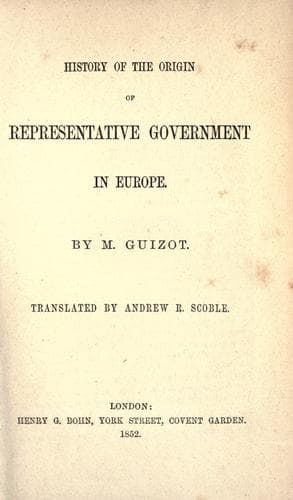
History of the Origin of Representative Government in EuropeGuizot, François
History
History of the Origin of Representative Government in Europe
Guizot, François
Europe -- History; Representative government and representation
17. In 680, Wamba was deposed by the intrigues of Erwig, who
was supported by the clergy. Wamba abdicated, and withdrew to a
convent. Erwig convoked the twelfth council of Toledo, at which
Wamba's voluntary abdication was announced, and Erwig appointed
his successor. The new monarch directed the council to revise
and modify the laws of Wamba regarding military service, and
the penalties to be imposed upon delinquents. A less severe
legislation was the work of the twelfth and thirteenth councils
of Toledo.
{214}
The Forum Judicum.
18. Erwig had given his daughter Cixilone in marriage to Egica,
a near relation of Wamba. In 687, Egica succeeded Erwig. He
charged the sixteenth council of Toledo to make a complete
collection of the laws of the Visigoths; and this collection,
under the name of the _Forum judicum_, or _Fuero
juzgo_, long ruled the Spanish monarchy.
19. Egica had associated with himself his son Witiza, who
succeeded him in 701. Witiza was tyrannical and dissolute. He
allowed the priests to marry, recalled the Jews, entered into
conflict with the Spanish clergy and the Pope; violently
persecuted the principal lay lords, among others Theutfred and
Favila, dukes of Cordova and Biscay, and sons of king
Chindasuinth; and fell a victim, in 710, to a conspiracy formed
against him by Roderic, son of Theutfred. Roderic, or Rodrigo,
became king of the Visigoths, and his reign was the last of
this monarchy. I shall not relate to you his wars with the
Saracens, or the celebrated adventure of Count Julian and his
daughter La Cava, who was violated by Roderic, or any of the
last scenes of this history which have now become popular
poetry. [Footnote 17] Political institutions are now the sole
subject of our study. In my next lectures, I shall tell you of
the _Forum judicum_, a very remarkable legislative work,
which deserves our serious examination and attention.
[Footnote 17: For the legend of Count Julian, and other
information regarding this most interesting period of Spanish
history, see Washington Irving's "Legends of the Conquest of
Granada and Spain," in Bohn's edition of his works.]
{215}
Lecture XXV.
Peculiar character of the legislation of the Visigoths.
Different sorts of laws contained in the _Forum judicum_.
It was a doctrine as well as a code.
Principles of this doctrine on the origin and nature of power.
Absence of practical guarantees.
Preponderance of the clergy in the legislation of the
Visigoths.
True character of the election of the Visigothic kings.
The Visigothic legislation characterized by a spirit of
mildness and equity towards all classes of men, and especially
towards the slaves.
Philosophical and moral merits of this legislation.
Character Of Visigothic Legislation.
Public-domain text, read in full here on John Shaqi.
Reviews
Reviews
No reviews yet
Be the first to share your thoughts on this work.
Elsewhere in the archive
Join the Discussion
Join the discussion
Sign in to leave a comment or review.
Sign InorCreate an account