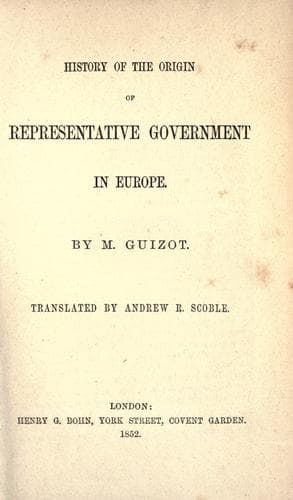
History of the Origin of Representative Government in EuropeGuizot, François
History
History of the Origin of Representative Government in Europe
Guizot, François
Europe -- History; Representative government and representation
Of all the Barbarian codes of law, that of the Visigoths is the
only one which remained in force, or nearly so, until modern
times. We must not expect to find in this code itself the only,
or even the principal, cause of this circumstance. And yet the
peculiar character of this code contributed powerfully to
determine its particular destiny; and more than one phase in
Spanish history is explained, or at least elucidated, by the
special and distinctive character of its primitive legislation.
This character I wish to make you thoroughly understand. I cannot
now deduce therefrom all the consequences which it contains; but
I think they will readily be perceived by the careful observer.
The legislation of the Visigoths was not, like that of the
Franks, Lombards, and others, the law of the Barbarian
conquerors. It was the general law of the kingdom, the code which
ruled the vanquished as well as the victors, the Spanish Romans
as well as the Goths. King Euric, who reigned from 466 to 484,
had the customs of the Goths written out. Alaric II., who ruled
from 484 to 507, collected and published in the
_Breviarium-Aniani_, the Roman laws which were applicable to
his Roman subjects. Chindasuinth, who reigned from 642 to 652,
ordered a revision and completion of the Gothic laws, which had
already been frequently revised and augmented since the time of
Euric; and completely abolished the Roman law.
{216}
Recesuinth, who reigned from 652 to 672, by allowing marriages
between the Goths and Romans, endeavoured completely to
assimilate the two nations: thenceforward, there existed, or at
least there ought to have existed, on the soil of Spain, one
single nation formed by the union of the two nations, and ruled
by one single code of laws, comprising the essential parts of the
two codes. Thus, whilst the system of personal laws, or laws
based on the origin of individuals, prevailed in most of the
Barbarian monarchies, the system of real laws, or laws based upon
land, held sway in Spain. The causes and consequences of this
fact are of great importance.
Laws Of The Forum Judicum.
Four different kinds of laws may be distinguished in the _Forum
judicum_.
1. Laws made by the kings alone, in virtue of their own
authority, or merely with the concurrence of their privy
council, _officium palatinum_.
2. Laws made in the national councils held at Toledo, in
concert with the bishops and grandees of the realm, and with
the assent, more frequently presumed than expressed, of the
people. At the opening of the council, the king proposed, in a
book called _tomus regius_, the adoption of new laws or
the revision of old ones; the council deliberated thereupon;
and the king sanctioned and published its decisions. The
influence of the bishops was predominant.
Public-domain text, read in full here on John Shaqi.
Reviews
Reviews
No reviews yet
Be the first to share your thoughts on this work.
Elsewhere in the archive
Join the Discussion
Join the discussion
Sign in to leave a comment or review.
Sign InorCreate an account