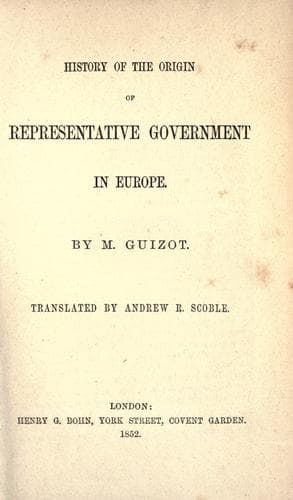
History of the Origin of Representative Government in EuropeGuizot, François
History
History of the Origin of Representative Government in Europe
Guizot, François
Europe -- History; Representative government and representation
Here we come to the junction-point of the two doctrines which
have ever contested, and still contest, the possession of the
world. One maintains that power comes from below; that, in its
origin as well as in right, it belongs to the people, to numbers;
and that those who exercise it, exercise it only as delegates, as
servants. This theory misunderstands the true principles and the
true nature of power; but it tends to constitute those guarantees
which rightfully belong to society. Considered as a theory, it
maintains, and assumes to render legitimate, the despotism of
numbers. But as, in practice, this despotism is impossible, it
soon violates its own principle, and limits its operation to the
organization of a system of guarantees, the object and result of
which is to constrain actual power to become, in its conduct,
rightful and legitimate power.
{220}
The opposite theory, which is more profound and true at its
starting-point, assigns absolute power and sovereignty to that
Being alone, in whom resides all truth and justice: it refuses
it, at the outset, to chiefs, as well as to peoples; it
subordinates both alike to eternal laws which they did not make,
and which they are equally bound to observe. It reasonably
affirms that all legitimate power comes from above, that it is
derived from superior reason, not from number, and that number
should submit to reason; but soon, forgetting that it has placed
sovereignty beyond the earth, and that no one here below is God,
it becomes dazzled by its own lustre; it persuades itself, or
tries to do so, that the power which comes from above, descends
upon earth as full and absolute as it is at its source; it is
indignant that limits should be affixed to its exercise, and if
there is nothing to stop its progress, it establishes, in fact, a
permanent despotism, after having denied, in principle, its
legitimacy; whereas, the opposite theory, which assumes to found
despotism in principle, almost invariably ends by destroying it
in fact, and by establishing only a limited power.
Consequences Of The Visigothic Theory.
Such, then, are the consequences of the theory regarding power
and law, conceived by the Visigothic legislators. I do not say
the consequences which logically flow from it, when the theory is
held in all its bearings and faithfully followed out; but the
actual consequences which it almost always entails, by the
natural tendency of things, and by the deviation into which they
are forced by the passions of mankind.
Public-domain text, read in full here on John Shaqi.
Reviews
Reviews
No reviews yet
Be the first to share your thoughts on this work.
Elsewhere in the archive
Join the Discussion
Join the discussion
Sign in to leave a comment or review.
Sign InorCreate an account