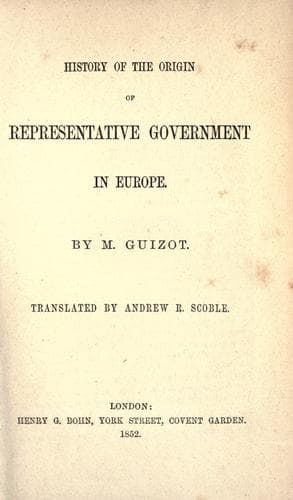
History of the Origin of Representative Government in EuropeGuizot, François
History
History of the Origin of Representative Government in Europe
Guizot, François
Europe -- History; Representative government and representation
This two-fold consequence of the definition of law frequently
occurs in the legislation of the Visigoths. "The king is called
king (_rex_) in that he governs justly (_recte_). If he
acts with justice, he legitimately possesses the name of king; if
he acts with injustice, he miserably loses it. Our fathers,
therefore, said with reason: _Rex ejus eris si recta facis; si
autem non facis, non eris_. The two chief virtues of royalty
are justice and truth." "The royal power, like the whole of the
people, is bound to respect the laws. Obeying the will of heaven,
we give, to ourselves as well as to our subjects, wise laws,
which our own greatness and that of oar successors is bound to
obey, as are also the whole population of our realm."
{219}
Limits Of These Theories.
"God, the Creator of all things, in arranging the structure of
the human body, raised the head above, and willed that thencefrom
should issue the nerves of all the members. And he placed in the
head the torch of the eyes, that thence might be detected all
things that might be injurious. And he established therein the
power of intellect, charging it to govern all the members, and
wisely to regulate their action. We must therefore first regulate
that which concerns princes, watch over their safety, protect
their life; and then ordain that which has relation to peoples,
in such sort that while suitably guaranteeing the safety of
kings, we may at the same time better guarantee that of the
peoples."
After having established that that power is alone legitimate
which acts according to justice and truth, which obeys and
prescribes the true law, and that all legitimate power comes from
above, and derives its legitimacy from itself, and not from any
terrestrial will, the theory of the councils of Toledo comes to a
stop. It does not regard that which is actually occurring in the
world: it forgets that, with such a definition, no one here below
possesses legitimate power or can fully possess it, and that,
nevertheless, society has a right to exact that actual power
should be legitimate. This theory knows and lays down the true
principles of power; but it neglects its guarantees.
Public-domain text, read in full here on John Shaqi.
Reviews
Reviews
No reviews yet
Be the first to share your thoughts on this work.
Elsewhere in the archive
Join the Discussion
Join the discussion
Sign in to leave a comment or review.
Sign InorCreate an account