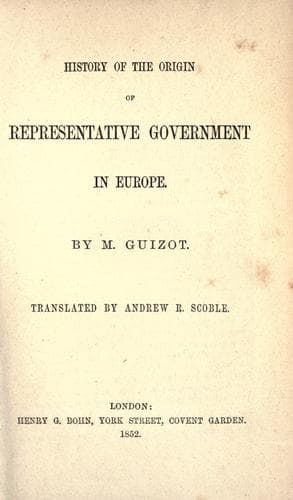
History of the Origin of Representative Government in EuropeGuizot, François
History
History of the Origin of Representative Government in Europe
Guizot, François
Europe -- History; Representative government and representation
My last lecture, I think, convinced you, gentlemen, that the code
of the Visigoths, taken in itself, and in its intentions as
expressed by written laws, gives the idea of a better social
state, a juster and more enlightened government, a better
regulated country, and, altogether, a more advanced and milder
state of civilization, than that which is revealed to us by the
laws of the other Barbarian peoples. But to this more humane and
wise legislation, to the general principles dictated by superior
reason, there is wanting, as I have already observed, an actual
sanction, an effective guarantee. The laws are good; but the
people, for whose benefit they were enacted, have hardly any
share in their execution, and the business resulting therefrom.
Up to a certain point, the code bears testimony to the wisdom and
good intentions of the legislature; but it presents no evidence
of the liberty and political life of the subjects.
Let us first look at the centre of the State. The single fact of
the political predominance of the bishops, the sole name of the
councils of Toledo, indicate the decay of the old Germanic
customs, and the disappearance of national assemblies. The
Anglo-Saxons had their _Wittenagemot;_ the Lombards their
assembly at Pavia, _circumstante immensâ multitudine;_ the
Franks their _Champs de Mars_ and _Champs de Mai_, and
their _placita generalia_. Doubtless, the existence of these
assemblies entailed scarcely any of the consequences which we
attach at the present day to the idea of such institutions; and
they certainly constituted a very slight guarantee of liberty,
which it was then impossible to guarantee.
{230}
In reality, also, they took a very small part in the government.
Nevertheless, the simple fact of their existence attests the
prevalence of Germanic customs; arbitrary power, though exercised
in fact, was not established in principle; the independence of
powerful individuals struggled against the despotism of the
kings; and in order to dispose of these isolated independencies,
to form them into a national body, it was necessary occasionally
to convoke them together in assemblies. These assemblies live in
the laws as well as in history; the clergy were received therein,
because of their importance and superior knowledge,--but they
were merely received. Far from being their sole constituents,
they did not even form their centre.
In Spain, instead of entering into the national assembly, the
clergy opened the assembly to the nation. Is it likely that the
name only was changed, and that Gothic warriors came to the
council, as formerly to their Germanic assemblies? We have beheld
the same name applied to very different things: for example,
judicial parliaments have superseded political parliaments; but
we have never seen the same thing represented under different
names, especially during the infancy of nations. When existence
consists almost solely of traditions and customs, words are the
last things to change and perish.
Public-domain text, read in full here on John Shaqi.
Reviews
Reviews
No reviews yet
Be the first to share your thoughts on this work.
Elsewhere in the archive
Join the Discussion
Join the discussion
Sign in to leave a comment or review.
Sign InorCreate an account