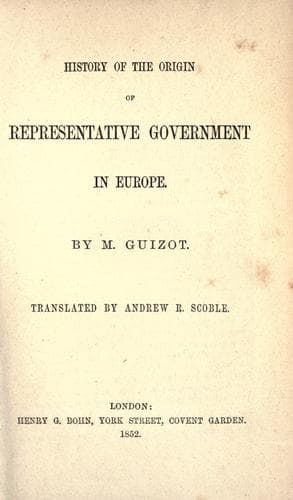
History of the Origin of Representative Government in EuropeGuizot, François
History
History of the Origin of Representative Government in Europe
Guizot, François
Europe -- History; Representative government and representation
The Councils Of Toledo.
The councils of Toledo, then, were actually councils, and not
_Champs de Mai_ or _placita_. Morally, this fact is
probable; historically, it is certain. Their acts have come down
to us, and they are acts of an entirely ecclesiastical assembly,
specially occupied with the affairs of the clergy; and into which
laymen entered only occasionally, and in small numbers. The
signatures of laymen, affixed to the canons of the thirteenth
council, only amount to twenty-six; and in no other are they so
numerous.
These councils were not held, like the _Champs de Mars_ or
_de Mai_ and the _placita generalia_ of the
Carlovingians, at fixed, or at least, frequent periods. Between
the third and fourth councils, forty-four years elapsed; between
the tenth and eleventh, eighteen years. The king convoked them at
his pleasure, or as necessity required. The Visigothic code
ordains absolutely nothing in this respect, either on the kings,
or on the members of the assembly. None of its enactments have
reference, even indirectly, to a national assembly.
{231}
Their Political Influence.
The nature of these councils of Toledo being thus clearly
determined, it remains for us to inquire what influence they
exerted in the government. What were they as guarantees of the
public liberties, and of the execution of the laws?
Before consulting special facts, the very nature of these
assemblies may furnish us with some general indications with
regard to their political influence. The clergy, taking a direct
and active part in the government, were never in a natural and
simple position. I do not speak either of the ecclesiastical law,
or of the special mission of the clergy, or of the separation of
the spiritual from the temporal order, which are questions still
involved in obscurity. I examine facts alone. In fact, in the
States of modern Europe, and at their origin, as well as in later
times, the clergy did not govern, they neither commanded armies,
nor administered justice, nor collected the taxes, nor held sway
over the provinces. They penetrated to a greater or less
distance, by more or less regular means, along the various paths
of political life; but they never traversed them fully, freely,
and thoroughly; politics never were their special and avowed
career. In a word, the social powers, from the lowest to the
highest degree, never were, either in law, or in fact, naturally
lodged in their hands. When the bishops, therefore, in council
assembled, interfered in the civil government, they were called
to regulate affairs which did not concern them, and to occupy
themselves about matters which did not constitute the habitual
and recognised business of their position and life. This
intervention, therefore, necessarily bore an equivocal and
uncertain character. Great influence might have been attached
thereto; but it could not possess any power of energetic and
effectual resistance. If warrior chiefs meet together in assembly
Public-domain text, read in full here on John Shaqi.
Reviews
Reviews
No reviews yet
Be the first to share your thoughts on this work.
Elsewhere in the archive
Join the Discussion
Join the discussion
Sign in to leave a comment or review.
Sign InorCreate an account