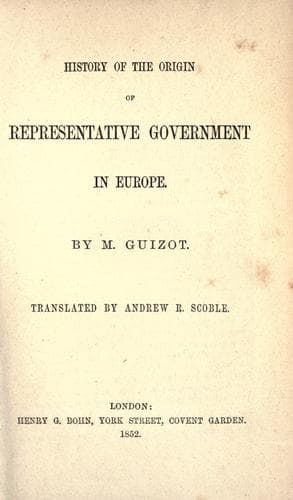
History of the Origin of Representative Government in EuropeGuizot, François
History
History of the Origin of Representative Government in Europe
Guizot, François
Europe -- History; Representative government and representation
If M. de Savigny has looked for the institutions of the Visigoths
in an epoch anterior to the definitive establishment of their
true monarchy, and in a collection of laws abolished by the
_Forum judicum_, the author of the dissertation contained in
the Edinburgh Review has addressed his inquiries to times and
documents posterior by four or five centuries to the destruction
of the kingdom of the Visigoths by the Arabs; and by transporting
the consequences which he has obtained therefrom into the epoch
which occupies our attention, he has fallen into an error still
less supported by facts than was that of M. de Savigny. His
researches and inferences are the following:--
"It must not be supposed that the whole body of the law of the
Visigoths appears in the twelve books of their code. They had
their common or traditionary law, still existing in unwritten
usages and customs, as well as their written law; and we are
supported by analogy in asserting that this common law often
spoke, when the statute law was silent. It outlived the
monarchy; and we now collect it from the _Fueros_ or
ancient customs of Castile and Leon. The customs in question
are preserved in the charters of the towns, which gave bye-laws
to the inhabitants, confirming the unwritten common law of the
country, sometimes with greater or lesser modifications in the
detail, but agreeing in general principles. We equally discover
them in the acts of Cortes, which, to borrow the expression of
Sir Edward Coke, are often 'affirmances of the common law.' The
traditionary Fueros of Castile also formed the basis of the
_Fuero Viejo de Castilla_, which received its last
revision under Peter the Third. And even Alonso the Wise,
though he planned the subversion of the ancient jurisprudence
of his kingdom, admitted into the Partidas such of those
_Fueros de España_ as relate to the tenures of land, and
to military service. Consisting of ancient usages, neither
refined by the learning of the councils nor restrained by the
power of the kings, the Fueros of Castile and Leon bear a
nearer affinity to the jurisprudence of the Teutonic nations
than the written code. The water ordeal is noticed only once,
in a law newly amended by Flavius Egica. But ordeal by
compurgation, the most ancient form of trial by jury, and the
battle ordeal, do not appear at all. Neither do we find any
notice of the custom of returning military leaders by the
_verdict of a jury_. All these customs, however, were
Fueros of Spain in the Middle Ages. Nor could they possibly
have then existed, had they not been preserved by immemorial
usage and tradition."
{247}
Election Of Adalides.
Public-domain text, read in full here on John Shaqi.
Reviews
Reviews
No reviews yet
Be the first to share your thoughts on this work.
Elsewhere in the archive
Join the Discussion
Join the discussion
Sign in to leave a comment or review.
Sign InorCreate an account