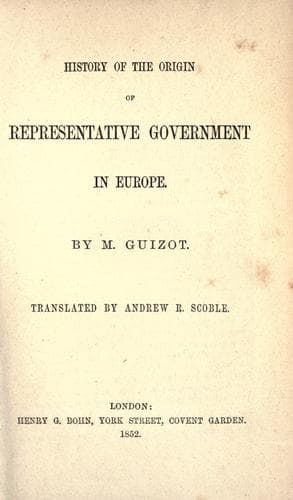
History of the Origin of Representative Government in EuropeGuizot, François
History
History of the Origin of Representative Government in Europe
Guizot, François
Europe -- History; Representative government and representation
The author then passes these ancient usages in review. The first
to which he refers is the appointment of military leaders by a
jury. He traces this custom back to the forests of Germany: and
then shows how it could not fail to succumb universally beneath
the establishment of the feudal system, and in consequence of the
hierarchical subordination of persons and lands. He discovers
traces of this in the nomination, by the people, of the
Anglo-Saxon _heretochs_ and _constables_, who were at
first military officers; and also in the election of the kings of
Norway by the verdicts of twelve of the principal men of each
province. He then returns to Spain, "where," he says, "we shall
find our old Gothic juries employed in electing the chief
officers of the army and navy of the Castilians, the Adalid, the
Almocaden, the Alfaqueque, and the Comitre. Who was to be the
Adalid? The question must be answered in the words of the wise
king Alonso. It is said by the ancients that 'the Adalid should
be endowed with four gifts--the first is wisdom, the second is
heart, the third is good common sense, and the fourth is loyalty;
and when a king or any other great lord wishes to make an Adalid,
he must call unto himself _twelve of the wisest_ Adalides
that can be found, and these must _swear_ that they will
_truly say_, if he whom they wish to choose to be an Adalid
hath the four gifts of which we have spoken, and if they answer
_yea_, then they are to make him an Adalid.'" Here we have
clearly an inquest by twelve men giving their verdict upon oath.
If it happened that twelve Adalides could not be found, then a
kind of _tales de circumstantibus_ was added to this special
jury of Adalides. The king or lord was to make up the full number
of twelve with other men well approved in war and deeds of arms,
and their verdict was as good as if they had been all Adalides.
And he who dared to act as an Adalid without being fully elected,
was to suffer death. "It was advised in ancient times," says
Alonso, "that they were to have the qualities before mentioned,
because it was necessary that they should possess them, in order
to be able to guide the troops and armies in time of war, and
therefore they were called Adalides, which is equivalent to
_guides_ (_que quiere tanto decir como guiadores_)."
{248}
Admission Of An Adalid.
The author is, therefore, of opinion that this word comes from
_adal, adel_, noble, and _leid, lead, leiten_, to guide
or conduct. The Adalid was the guide or chief of the
_Almogavars_, or cavalry soldiers. The _Adalid mayor_
was commander-in-chief of all the Almogavars, or Castilian
cavalry.
Public-domain text, read in full here on John Shaqi.
Reviews
Reviews
No reviews yet
Be the first to share your thoughts on this work.
Elsewhere in the archive
Join the Discussion
Join the discussion
Sign in to leave a comment or review.
Sign InorCreate an account