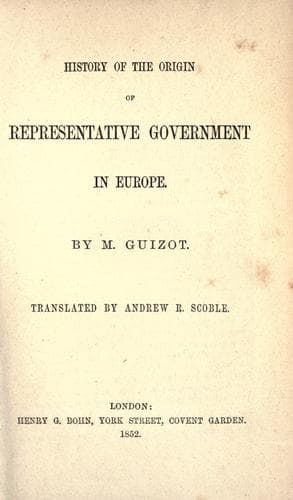
History of the Origin of Representative Government in EuropeGuizot, François
History
History of the Origin of Representative Government in Europe
Guizot, François
Europe -- History; Representative government and representation
"The customs of St. Sebastien in Guipuscoa, allowed an odd kind
of proceeding, resembling the assessment of damages by the
verdict of a jury. The ravisher was to pay the price of
virginity, or he was to marry the object of his ungovernable
passion; which punishment, as the charter wisely observes, 'is
fully equal to a fine.' But if she, who had been a maid, was
unworthy of becoming his wife, he was to provide her with such a
husband as she might have reasonably expected to have obtained
previous to her mishap, 'according to the estimation of the
alcalde, and of twelve good men of St. Sebastien.'
"The fullest directions concerning the use of the ordeal are
contained in the charter of Molina. Don Molrique de Lara
incorporated the town of Molina, the seigniory of the noble house
of Lara, in the year 1152. His charter may be quoted as the most
valuable record concerning the ancient municipal jurisprudence of
Castile which has yet been published, as it displays the entire
constitution and government of a Castilian town. ... Fines,
according to the old Gothic law, were enacted at Molina for
wounds and maims. The accuser was to support his charge by three
'_vecinos_' or burghers of the town, if the offence was
committed within its walls.
{252}
Two _vecinos_ sufficed if without. And, in default of full
proof, the culprit either swore with twelve _vecinos_, or
fought with the accuser; but the latter had the choice of the
ordeal. ... When a murder had been committed, if one of those
engaged in the fray took the guilt on his own head, saying,
'_I killed him_,' the others were 'to save themselves with
twelve true burghers,'--_los otros salvense con doce vecinos
derecheros_. It might happen, that none would confess the
crime; and as all were then equally liable to suspicion, the
relations of the dead man were at liberty to select any one as
the murderer, 'just as they thought fit;' after which the
supposed murderer named eleven relations of the slain, and
these, together with the accuser, swore to his being guilty or
not guilty. Unanimity was required; and if one or two would not
swear, that is to say, if they could not agree with the
majority, each one who was so dissentient swore with twelve,
that neither he, nor any one for his use, had received any
bribe; then he was discharged. But if the defendant did not
'fall' by the withdrawing of his juror, he was at liberty to
name another. This proceeding is remarkable; a new aspect is
given to the ordeal by calling in the compurgators to swear with
the accuser instead of the accused; and in this form it is,
perhaps, more closely assimilated to a jury-trial. It may be
observed, that a practice once prevailed in England of
withdrawing the dissentient jurors, and replacing them by
others, till an unanimous verdict was obtained."
Public-domain text, read in full here on John Shaqi.
Reviews
Reviews
No reviews yet
Be the first to share your thoughts on this work.
Elsewhere in the archive
Join the Discussion
Join the discussion
Sign in to leave a comment or review.
Sign InorCreate an account