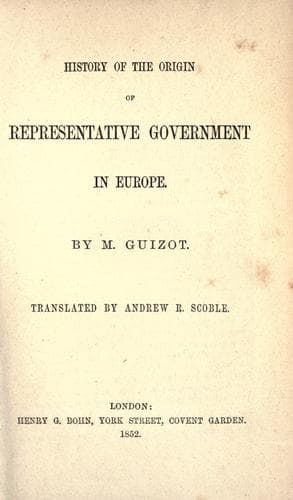
History of the Origin of Representative Government in EuropeGuizot, François
History
History of the Origin of Representative Government in Europe
Guizot, François
Europe -- History; Representative government and representation
"Three thousand _sueldos_, according to the _Fuero
Viejo_, were paid for dishonouring the palace of the king, or
spoiling his castle; and five hundred _sueldos_ was the
price of the head of the _merino_, or the composition for
scandalizing him; and every man who wished to save himself from
the payment of these mulcts, was to defend himself by the oath of
_twelve men, for such was the usage of Castile in the old
time_. When accused of the death of another _fijo
d'algo_, the suspected noble defended himself by the oath of
eleven other _fijos d'algo_, himself _the twelfth_,
and, as true knights, they were all _sworn_ upon the Gospel
Book, with their spurs upon their heels. There were two insults
only which gave a Dueña, or a squire, the right of complaining
that a _fijo d'algo_ had scandalized them, viz., a blow or a
wound, or the robbery of their mules or garments. Within three
days, the party so injured by a caitiff knight was obliged to
complain of the offence, and to disclose the injury to the
_fijos d'algo_ of the town, the _labradores_, and to
the inmates of the _fijos d'algo_, if there were any, and to
cause the town-bell to be rung, saying, "such a one hath thus
dishonoured me."
{251}
These formalities having been observed, the _fijo d'algo_
was bound to answer the complaint; reparation was made if he
confessed it, by forfeiting five hundred _sueldos_, the
price of his own head; but if he denied it, he was to clear
himself by the oath of eleven other _fijos d'algo_, himself
the _twelfth_. But a _labrador_ accused of injuring a
_fijo d'algo_ was not to be admitted to defend himself by
his peers; and he was unfairly compelled to swear with eleven
_fijos d'algo_, himself the twelfth.
"These customs are taken from the general code. In peculiar
districts, compurgation was so much in vogue, that compurgatrixes
were allowed to female culprits. At Anguas, as well as in other
towns, a woman charged with theft could defend herself by the
oaths of a jury of other women. More whimsical was the Fuero of
Cuenca, which is passing strange, both for the spirit of the law
and the terms in which it is expressed. If perchance any husband
suspected that his wife had planted horns upon his head, although
he was not able to prove the fact by evidence, the wife was to
justify herself by swearing to her chastity, with twelve good
wives of the neighbourhood; and if they pronounced her to be
pure, her husband was obliged to be persuaded that she was so.
Public-domain text, read in full here on John Shaqi.
Reviews
Reviews
No reviews yet
Be the first to share your thoughts on this work.
Elsewhere in the archive
Join the Discussion
Join the discussion
Sign in to leave a comment or review.
Sign InorCreate an account