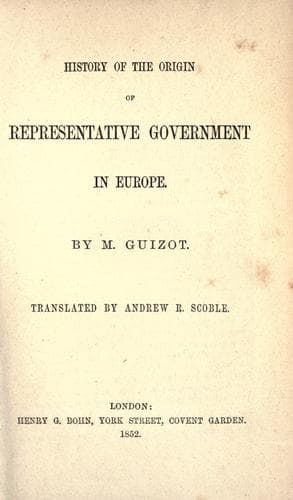
History of the Origin of Representative Government in EuropeGuizot, François
History
History of the Origin of Representative Government in Europe
Guizot, François
Europe -- History; Representative government and representation
individual characters take up less space, and no longer appear
under living forms; the mention of names becomes more rare; the
narrative of events, and the description of men, are more its
pretext than its subject; all becomes generalized; readers demand
a summary of the development of civilization, a sort of theory of
the peoples and of events; history becomes a series of
dissertations on the progress of the human race, and the
historian seems only to call up the skeleton of the past, in
order to hang upon it general ideas and philosophic reflections.
This occurred in the last century; the English historians of that
period, Robertson, Gibbon, and Hume, have represented history
under that aspect; and most of the German writers still follow
the same system. The philosophy of history predominates; history,
properly so called, is not to be found in them.
{260}
The History Of Free Nations.
But if advanced civilization and a great development of the human
intellect coincide, in a nation, with an animated and keen
political existence; if the struggle for liberty, by exciting the
mind, provoke energy of character; if the activity of public life
be added to the general claims of thought, history appears in
another light; it becomes, so to speak, practical. No longer is
it required to charm easily excited imaginations by its
narratives, nor to satisfy by its meditations active intellects
debarred from exercising themselves upon aught but generalities.
But men expect from it experience analogous to the wants they
feel, to the life they live; they desire to understand the real
nature and hidden springs of institutions; to enter into the
movements of parties, to follow them in their combinations, to
study the secret of the influence of the masses, and of the
action of individuals; men and things must resuscitate before
them, no longer merely as an interest or diversion, but as a
revelation of how rights, liberties, and power are to be
acquired, exercised, and defended; how to combine opinions,
interests, passions, the necessities of circumstances, all the
elements of active political life. That is what history becomes
for free nations; it is from that point of view that Thucydides
wrote the history of the Peloponnesian war, Lord Clarendon and
Bishop Burnet that of the English Revolution.
Generally, and by the very nature of things, it is in regular
order, and at distant intervals, that history assumes one or
other of these various kinds of interest in the eyes of the
people. A taste for simple narratives, a liking for philosophic
generalizations, and a craving for political instruction, almost
always belong to very different times and degrees of
civilization.
Historic Requirements Of The Present Age.
Public-domain text, read in full here on John Shaqi.
Reviews
Reviews
No reviews yet
Be the first to share your thoughts on this work.
Elsewhere in the archive
Join the Discussion
Join the discussion
Sign in to leave a comment or review.
Sign InorCreate an account