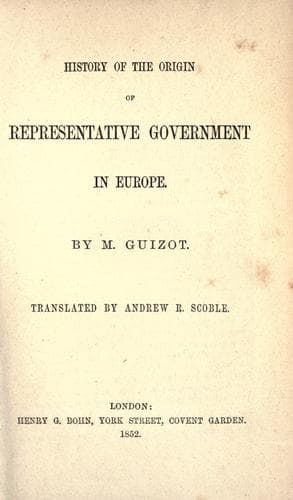
History of the Origin of Representative Government in EuropeGuizot, François
History
History of the Origin of Representative Government in Europe
Guizot, François
Europe -- History; Representative government and representation
By a rare concurrence of circumstances, all these tastes and
acquirements seem to unite at the present day; and history is now
susceptible amongst us of all these kinds of interest. If it
narrate to us with truth and simplicity the first attempts at
social life, the manners of infant nations; that singular state
of society in which ideas are few in number but keen, and wants
are energetic although unvaried, in which all the pretensions of
barbarian force struggle against all the habits of wild liberty,
it will find us capable of understanding such a recital, and
somewhat disposed to be charmed therewith.
{261}
Fifty years ago, a faithful picture of this age in the life of
peoples would have appeared only coarse and revolting; its
interesting and poetical character would have been neither
relished nor understood; conventionalisms were then turned into
habits, and factitious manners held sway over the whole of
society; Homer himself, in an age so destitute of simplicity and
naturalness, was admired on hearsay only; and if no one dared to
call in question his title to glory, he was pitied for having
been obliged to shed the lustre of his genius upon an epoch of
barbarism and ignorance. Prodigious events have since renewed the
state of society, broken up old forms, conventional habits, and
factitious manners; simple ideas and natural feelings have
resumed their empire; a kind of rejuvenescence has taken place in
the minds of men, and they have become capable of understanding
man at every degree of civilization, and of taking pleasure in
the simple and poetic narratives of infant society. In our days
it has been felt that barbarian times also deserved, in some
respects, to be called heroic times; in our days, mankind has
discovered the faculty, as well as the necessity, of obtaining a
true knowledge of the institutions, ideas, and manners of
peoples, on their entrance into social life. Thus this section of
history has regained an interest which it had ceased to possess;
it is no longer regarded as the patrimony of the erudite; it has
been seized upon by novelists themselves, and the public have
taken delight in following their footsteps.
Public-domain text, read in full here on John Shaqi.
Reviews
Reviews
No reviews yet
Be the first to share your thoughts on this work.
Elsewhere in the archive
Join the Discussion
Join the discussion
Sign in to leave a comment or review.
Sign InorCreate an account