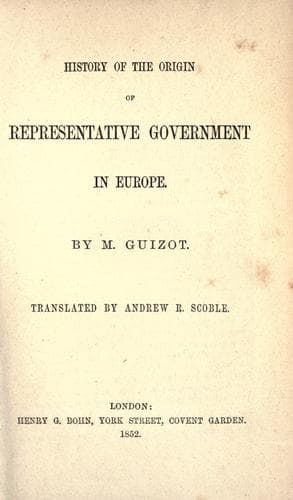
History of the Origin of Representative Government in EuropeGuizot, François
History
History of the Origin of Representative Government in Europe
Guizot, François
Europe -- History; Representative government and representation
At the same time, the need of broad philosophical views of the
course of human affairs and the progress of society, has gained
strength instead of becoming extinguished; we have not ceased to
look to facts for something more than mere narratives; we still
expect them to be summed up in general ideas, and to furnish us
with those great results which throw light on the sciences of
legislation and political economy, and on the vast study of the
destiny of the human race. Far, then, from being less inclined to
consider history under a philosophic point of view, it seems to
have acquired a wider interest in this respect. More than ever,
we feel the necessity of tracing events back to their primitive
causes, of reducing them to their simplest expression, of
penetrating into their remotest effects; and if old chronicles
have regained their charm in our eyes, the great combinations of
historic philosophy still constitute a pressing necessity of our
minds.
{262}
Necessity Of An Acquaintance With History.
Finally, our birth into public life, the institutions that we
possess and that we will not lose, that aurora of liberty which,
though it arose in the midst of tempests, is not destined to
perish therein, the past which we leave behind us, the present
with which we are busied, the future which awaits us, in fine,
our entire position--all impart to history, considered under the
political point of view, the most imperious interest. Before our
time, the movement of public life, the game of parties, the war
of factions, the struggles of assemblies, all the agitations and
developments of power and liberty, were things which men had
heard of but had not seen, which they had read of in books but
which were not actually existing around the reader. These things
have occurred, and are now occurring under our very eyes; every
consideration leads us to study them, every circumstance aids us
to comprehend them. And not to us alone has political life been
restored: it has returned into history, hitherto cold and vague
to the minds of those who had not been struck by the real visions
of the scenes which it relates. And while regaining our
comprehension of history, we have also become aware of the
counsels and the lessons which it can furnish us; its utility no
longer consists, as formerly, in a general idea, a sort of moral
and literary dogma professed by writers rather than adopted and
practised by the public. Now, a more or less thorough
acquaintance with history, and especially with that of free
peoples, is not merely an accomplishment of cultivated minds; it
is a necessity to every citizen who feels desirous to take part
in the affairs of his country, or merely to appreciate them
correctly. And thus this great study now presents itself to us
with all the kinds of interest that it is able to offer, because
we have in us ability to consider it under all its aspects, and
to seek and to find all that it contains.
{263}
Public-domain text, read in full here on John Shaqi.
Reviews
Reviews
No reviews yet
Be the first to share your thoughts on this work.
Elsewhere in the archive
Join the Discussion
Join the discussion
Sign in to leave a comment or review.
Sign InorCreate an account