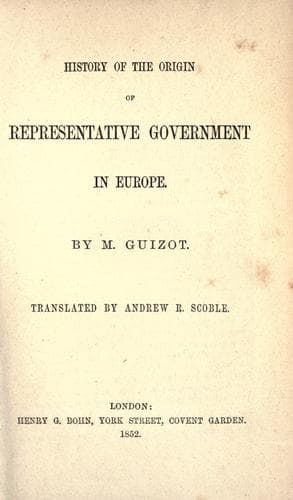
History of the Origin of Representative Government in EuropeGuizot, François
History
History of the Origin of Representative Government in Europe
Guizot, François
Europe -- History; Representative government and representation
There are two great theories of sovereignty. One seeks for it and
places it in some one of the real forces which exist upon the
earth, no matter whether it be the people, the monarch, or the
chief men of the people. The other maintains that sovereignty as
a right can exist nowhere upon earth, and ought to be attributed
to no power, for no earthly power can fully know and constantly
desire truth, reason, and justice,--the only sources of
sovereignty as a right, and which ought also to be the rule of
sovereignty in fact. The first theory of sovereignty founds
absolute power, whatever may be the form of the government. The
second combats absolute power in all its forms, and recognises
its legitimacy in no case. It is not true to say that of these
two theories, one or the other reigns exclusively in the various
governments of the world. These two theories commingle in a
certain measure; for nothing is completely destitute of truth or
perfectly free from error. Nevertheless, one or the other always
dominates in every form of government, and may be considered as
its principle.
The true theory of sovereignty, that is, the radical illegitimacy
of all absolute power, whatever may be its name and place, is the
principle of representative government.
In fact, in representative government, absolute power,
sovereignty as a right, inhere in none of the powers which concur
to form the government: they must agree to make the law; and even
when they have agreed, instead of accepting for ever the absolute
power which actually results from their agreement, the
representative system subjects this power to the variableness of
election. And the electoral power itself is not absolute, for it
is confined to the choice of the men who shall have a share in
the government.
It is, moreover, the character of that system, which nowhere
admits the legitimacy of absolute power, to compel the whole body
of citizens incessantly, and on every occasion, to seek after
reason, justice, and truth, which should ever regulate actual
power. The representative system does this,
1. by discussion, which compels existing powers to seek after
truth in common;
2. by publicity, which places these powers when occupied in
this search, under the eyes of the citizens; and
3, by the liberty of the press, which stimulates the citizens
themselves to seek after truth, and to tell it to power.
{265}
Characteristics Of Representative Government.
Finally, the necessary consequence of the true theory of
sovereignty is, that all actual power is responsible. If, in
fact, no actual power possesses sovereignty as a right, they are
all obliged to prove that they have sought after truth, and have
taken it for their rule; and they must legitimize their title by
their acts, under penalty of being taxed with illegitimacy. The
responsibility of power is, in fact, inherent in the
representative system; it is the only system which makes it one
of its fundamental conditions.
Public-domain text, read in full here on John Shaqi.
Reviews
Reviews
No reviews yet
Be the first to share your thoughts on this work.
Elsewhere in the archive
Join the Discussion
Join the discussion
Sign in to leave a comment or review.
Sign InorCreate an account