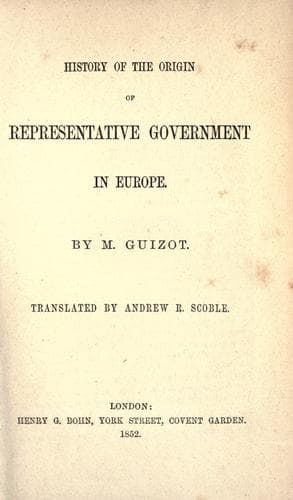
History of the Origin of Representative Government in EuropeGuizot, François
History
History of the Origin of Representative Government in Europe
Guizot, François
Europe -- History; Representative government and representation
After having recognised the principle of representative
government, we investigated its external characteristics, that is
to say, the forms which necessarily accompany the principle, and
by which alone it can manifest its existence. These forms we
reduced to three:
1. division of powers;
2. election; and
3. publicity.
It is not difficult to convince ourselves that these
characteristics necessarily flow from the principle of
representative government. Indeed,
1. all sole power in fact soon becomes absolute in right. It is
therefore necessary that all power in fact should be conscious
of dependence. "All unity," says Pascal, "that is not
multitude, is tyranny." Hence results the necessity for two
Houses of Parliament. If there be only one, the executive power
either suppresses it, or falls into so subaltern a condition
that there would soon remain only the absolute power of the
single House of Parliament.
2. Unless election occurred frequently to place power in new
hands, that power which derived its right from itself would
soon become absolute in right; this is the tendency of all
aristocracies.
3. Publicity, which connects power with society, is the best
guarantee against the usurpation of sovereignty as a right by
the actual power.
Representative government can neither be established nor
developed without assuming, sooner or later, these three
characteristics; they are the natural consequences of its
principle; but they do not necessarily co-exist, and
representative government may exist without their union.
This was the case in England. It is impossible not to enquire why
representative government prevailed in that country, and not in
the other States of the Continent. For, indeed, the Barbarians
who settled in Great Britain had the same origin and the same
primitive manners as those who, after the fall of the Roman
Empire, overran Europe; and it was not in the midst of very
different circumstances that they consolidated their dominion in
that country.
{266}
From the fifth to the twelfth century, we find no more traces of
true representative government in England than upon the
Continent; its institutions were analogous to those of the other
European nations; and we behold in every land the conflict of the
three systems of free, feudal, and monarchical institutions.
We cannot fully resolve this question beforehand, and in a
general manner. We shall answer it gradually, as we advance in
the examination of facts. We shall see by what successive and
varied causes political institutions took a different course in
England to that which they pursued on the Continent. We may,
however, indicate at once the great fact which, from a very early
period, determined the character and direction of British
institutions.
Division Of Power.
Public-domain text, read in full here on John Shaqi.
Reviews
Reviews
No reviews yet
Be the first to share your thoughts on this work.
Elsewhere in the archive
Join the Discussion
Join the discussion
Sign in to leave a comment or review.
Sign InorCreate an account