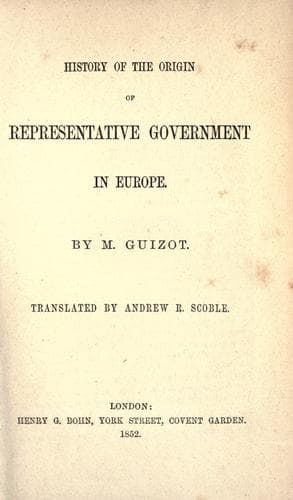
History of the Origin of Representative Government in EuropeGuizot, François
History
History of the Origin of Representative Government in Europe
Guizot, François
Europe -- History; Representative government and representation
But when the sentiment of right lives in the souls of men, when
the citizen meets with no power in his country which he is bound
to consider as infallible and absolutely sovereign, liberty can
never fail to spring up. It has developed itself in England less
universally, less equally, and less reasonably, we venture to
believe, than we are permitted to hope will be the case at the
present day in our own country; but, in fine, it was born, and
increased in growth in that country more than in any other; and
the history of its progress, the study of the institutions which
served as its guarantees, and of the system of government to
which its destinies seem henceforward to link themselves, is at
once a great sight and a necessary work for us. We shall enter
upon it with impartiality, for we can do so without envy.
{270}
Lecture II.
Sketch of the History of England, from William the Conqueror to
John Lackland (1066-1199).
William the Conqueror (1066-1087).
William Rufus (1087-1100).
Henry I. (1100-1135).
Stephen (1135-1154).
Henry II. (1154-1189).
Constitutions of Clarendon.
Richard Cœur de Lion (1189-1199).
Early History Of England.
Before entering upon the history of representative government in
England, I think it necessary, in the first place, to remind you
of the facts which served, as it were, as its cradle--of the
movements of the different nations which successively occupied
England--the conquest of the Normans--the state of the country
at the period of this conquest, about the middle of the eleventh
century--and the principal events which succeeded it. A knowledge
of facts must always precede the study of institutions.
The Britons,--Gauls or Celts in origin,--were the first
inhabitants of Great Britain. Julius Caesar subjugated them, and
the Roman dominion substituted a false and enervating
civilization in the place of their barbarian energy. On being
abandoned by Rome, when that city abdicated piecemeal the empire
of the world, the Britons were unable to defend themselves, and
summoned the Saxons to their assistance. The latter, finding them
already conquered, from their allies became ere long their
masters, and exterminated or drove back into the mountains of
Wales, the people whom the Romans had subdued. After a long
series of incursions, the Danes established themselves in the
north of England, during the ninth century, and in the latter
part of the eleventh century, the Normans conquered the whole
country.
The Norman Conquest.
Public-domain text, read in full here on John Shaqi.
Reviews
Reviews
No reviews yet
Be the first to share your thoughts on this work.
Elsewhere in the archive
Join the Discussion
Join the discussion
Sign in to leave a comment or review.
Sign InorCreate an account