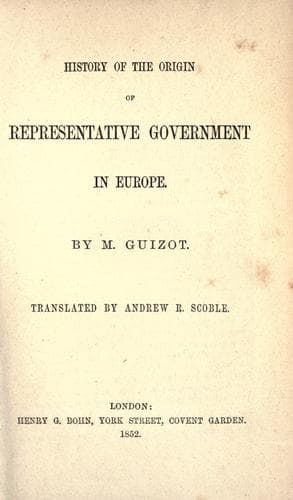
History of the Origin of Representative Government in EuropeGuizot, François
History
History of the Origin of Representative Government in Europe
Guizot, François
Europe -- History; Representative government and representation
2. The division of the supreme power produced yet another
result. When the towns had acquired greater wealth and
importance, when there had been formed, beyond the circle of
the king's immediate vassals, a nation capable of taking part
in political life, and which the government found it necessary
to treat with consideration, this nation naturally adjoined
itself to the great council of the king, which had never ceased
to exist. In order to gain itself a place in the central
government, it had no need abruptly to create new institutions;
a place was already prepared to receive it, and although its
entrance into the national council ere long changed its nature
and forms, it at least was not under the necessity of asserting
and re-animating its existence. There was a fact capable of
receiving extension, and of admitting into its bosom new facts,
together with new rights. The British Parliament, to say truth,
dates only from the formation of the House of Commons; but
without the presence and importance of the council of Barons,
the House of Commons would, perhaps, never have been formed.
Thus, on the one hand, the permanence of the idea that the
sovereignty ought to be limited, and, on the other, the actual
division of the central power, were the germs of representative
government in England. Until the end of the thirteenth century we
met with no other of its characteristics; and the English nation,
until that period, was not perhaps actually more free and happy
than any of the peoples of the Continent. But the principle of
the right of resistance to oppression was already a legal
principle in England; and the idea of the supremacy which holds
dominion over all others, of the supremacy of the law, was
already connected, in the mind of the people and of the
jurisconsults themselves, not with any particular person, or with
any particular actual power, but with the name of the law itself.
Already the law was said to be superior to all other powers;
sovereignty had thus, in principle at least, left that material
world in which it could not fix itself without engendering
tyranny, to place itself in that moral world, in which actual
powers ought constantly to seek it. Many favourable circumstances
were doubtless necessary to fecundate these principles of liberty
in England.
{269}
Sources Of Liberty.
Public-domain text, read in full here on John Shaqi.
Reviews
Reviews
No reviews yet
Be the first to share your thoughts on this work.
Elsewhere in the archive
Join the Discussion
Join the discussion
Sign in to leave a comment or review.
Sign InorCreate an account