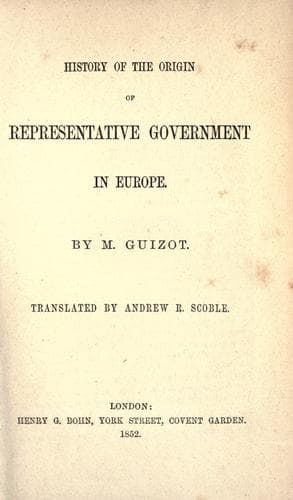
History of the Origin of Representative Government in EuropeGuizot, François
History
History of the Origin of Representative Government in Europe
Guizot, François
Europe -- History; Representative government and representation
Henry I. usurped the crown of England from his brother Robert, to
whom it rightfully belonged; and the Norman barons, who preferred
Robert, offered only a feeble resistance to Henry; he was crowned
in London. His first act was a charter, in which, to gain
forgiveness for his usurpation, he promised not to seize upon the
revenues of the church during the vacancy of benefices; to admit
the heirs of the crown vassals to the possession of their
estates, without exposing them to such violent exactions as had
been usual during the preceding reigns; to moderate the taxes, to
pardon the past, and finally to confirm the authority of the laws
of St. Edward, which were so dear to the nation. A short time
after the concession of this charter, Henry married Matilda, the
daughter of the King of Scotland, and niece of Edgar Atheling,
the last heir of the Saxon dynasty; by this marriage he hoped to
conciliate the attachment of the Saxon people. In order to marry
him, Matilda was liberated from her vows, for she had taken the
veil, not with the intention of becoming a nun, says Eadmer, but
in order to escape from the brutal violence of the Normans.
In 1101, Robert returned from the Crusades, and invaded England,
but a treaty soon put a stop to his progress, and he renounced
his pretensions on receiving a pension of 3000 marks, and the
promise of succeeding to Henry's inheritance. The bad government
of Robert in Normandy occasioned continual disturbances in that
country, and maintained the ever-increasing tendency towards the
union of Normandy with England. Henry, taking advantage of this
state of things, invaded Normandy, where he had many powerful
adherents, and after three years of war, in 1106, the battle of
Tenchebray decided the fate of Robert, who was taken prisoner and
confined in Cardiff Castle, where he languished twenty-eight
years. Normandy was then united to England.
The reign of Henry I. was disturbed by continual quarrels with
the clergy; he was obliged to renounce the right of investiture,
which was held to confer spiritual dignity, but the bishops
continued to swear to him fidelity and homage, by reason of their
temporal possessions. In the midst of the obstacles which lay in
his path, Henry governed with vigour and prudence; he humbled the
great barons, restored order, and restrained the clergy; and
these were the qualities which then constituted a great king. The
pretended code which is ascribed to Henry I. is a later
compilation; but he effected several important reforms, among
others, by repressing the abuses of the right of purveyance, by
which the socage tenants of the king were bound gratuitously to
supply the court, while journeying, with provisions and
carriages. It is also said that he substituted, for tenants of
this class, the payment of a money rent instead of the rent in
kind which they had formerly paid; but it is not probable that
this was a general rule.
{274}
Wars Of Stephen And Matilda.
Public-domain text, read in full here on John Shaqi.
Reviews
Reviews
No reviews yet
Be the first to share your thoughts on this work.
Elsewhere in the archive
Join the Discussion
Join the discussion
Sign in to leave a comment or review.
Sign InorCreate an account