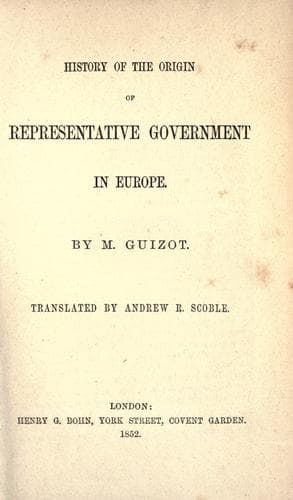
History of the Origin of Representative Government in EuropeGuizot, François
History
History of the Origin of Representative Government in Europe
Guizot, François
Europe -- History; Representative government and representation
Henry I. died in 1135. His reign promoted, to some extent, the
fusion of the two peoples: but the separation was still wide. His
son William being dead, Henry had appointed as his successor his
daughter Matilda, the wife of Geoffrey Plantagenet, Count of
Anjou; and an assembly of barons had ratified his choice. But,
during the absence of Matilda, Stephen, Count of Boulogne, the
grandson of William the Conqueror by his mother Adela, the wife
of Stephen, Count of Blois, usurped the crown of England; but
only a few barons attended at his coronation, on the 22nd of
December, 1135. Stephen was anxious, by making large concessions,
to obtain pardon for his usurpation; and he published two
charters, which promised all that those issued by Henry had
promised, including the maintenance of the laws of Edward the
Confessor. The clergy and barons, however, swore to him only a
conditional oath; and wishing to make him pay dearly for their
support, the church exacted from him the sanction of all its
privileges, and the barons obtained permission to build
fortresses upon their estates. The kingdom soon bristled with
castles and ramparts. Eleven hundred and fifteen were erected
during the reign of Stephen, and assured, far more effectually
than his charters, the power and independence of the barons.
In 1139, an insurrection broke out in favour of Matilda. King
Stephen was defeated and made prisoner at the battle of Lincoln,
on the 26th of February, 1141. A synod of ecclesiastics, without
the co-operation of any laymen, gave the crown to Matilda; the
deputies of the city of London were the only laymen present, and
they demanded the liberation of King Stephen, but in vain; they
were admitted into the synod merely to receive orders. A
conspiracy against Matilda overthrew, ere long, the bold work of
the clergy; Stephen regained his liberty in 1142, and the civil
war recommenced.
{275}
Reign Of Henry II.
But a new enemy had now arisen against him. Prince Henry, the son
of Matilda, though still young, had already rendered himself
remarkable for his bravery and prudence. His mother promised him
the dukedom of Normandy; the death of his father, Geoffrey
Plantagenet, had given him Maine and Poitou; and his marriage
with Eleanor of Guienne had gained him two other vast provinces
of France. In 1154, he appeared in England with an army, but a
negotiation speedily terminated the conflict, and Henry was
acknowledged as the successor of Stephen, who died a year
afterwards, on the 25th of October, 1154.
Public-domain text, read in full here on John Shaqi.
Reviews
Reviews
No reviews yet
Be the first to share your thoughts on this work.
Elsewhere in the archive
Join the Discussion
Join the discussion
Sign in to leave a comment or review.
Sign InorCreate an account