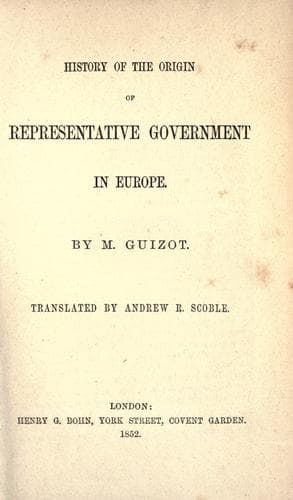
History of the Origin of Representative Government in EuropeGuizot, François
History
History of the Origin of Representative Government in Europe
Guizot, François
Europe -- History; Representative government and representation
A variety of circumstances were favourable to the power of Henry
II. at his accession. He united in his own person the rights of
both the Saxon and Norman dynasties. He possessed immense
dominions on the Continent; he was Count of Anjou, Duke of
Normandy, Duke of Guienne, Maine, Saintonge, Poitou, Auvergne,
Périgord, Augoumois and Limousin. He married his third son,
Geoffrey, while still a child, to the infant heiress of the duchy
of Brittany. He soon became engaged in war with the nobility and
the clergy. He revoked all the gifts of the royal domains which
had been granted by Stephen and Matilda, and regained by arms all
that was not restored to him peaceably. He demolished a large
number of the feudal fortresses. No coalition of the barons had
as yet been formed, and their individual power was utterly unable
to compete with that of Henry; they therefore submitted. The king
also rallied around him a great number of interests by the
maintenance of strict order, and by the appointment of itinerant
justices to secure a more equitable administration of the laws.
His struggle with the clergy was more stormy, and its success
less complete; for the clergy, who were already constituted into
a most powerful corporation, and were sustained from without by
the Holy See, had found within their own body a chieftain capable
of resisting even the greatest monarch. Thomas Becket, born in
London in 1119, had advanced so far in the favour of Henry as to
be appointed his Lord High Chancellor. His services, his
devotedness, the magnificence of his mode of life, all combined
to persuade Henry that, by elevating Becket to the highest
ecclesiastical dignities, he would gain a powerful supporter in
the church; he, therefore, had him appointed Archbishop of
Canterbury and Primate of the kingdom.
{276}
Constitutions Of Clarendon.
But no sooner was Becket appointed to this office than he devoted
himself to the interests of his order, and boldly undertook to
exercise, and even to extend the rights of his position. A clerk
had committed a murder; Becket punished him according to the laws
of the clergy: Henry desired to have him judged by the civil law;
Becket resisted; and Henry seized this opportunity for attacking
openly and systematically the ecclesiastical power. He assembled
the bishops, and inquired of them whether they would submit to
the ancient laws of the realm, or not; and they were forced to
consent to do so. The famous Council of Clarendon was convoked in
1164 to define these laws, and fix the limits of the two powers.
The king had conciliated the support of the lay barons. Sixteen
articles resulted from the deliberations of this assembly; they
are to the following effect:
1. All suits concerning the advowson and presentation of
churches shall be determined in the civil courts.
Public-domain text, read in full here on John Shaqi.
Reviews
Reviews
No reviews yet
Be the first to share your thoughts on this work.
Elsewhere in the archive
Join the Discussion
Join the discussion
Sign in to leave a comment or review.
Sign InorCreate an account