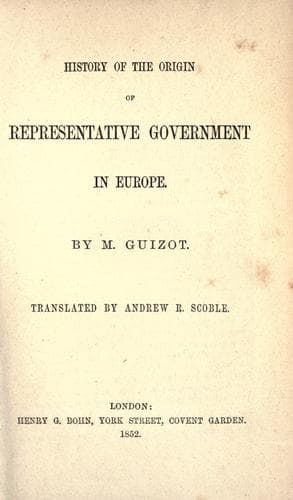
History of the Origin of Representative Government in EuropeGuizot, François
History
History of the Origin of Representative Government in Europe
Guizot, François
Europe -- History; Representative government and representation
Richard set out at length for the Crusades, leaving as Regent
during his absence his mother Eleanor, who had excited the
princes her sons to rebellion against the king their father; and
he associated the Bishops of Durham and Ely with her in the
regency. The tyranny of the Bishop of Ely spread confusion
throughout England; he placed his colleague under arrest, and
governed alone with boundless arrogance, until at last Prince
John had him deposed by a council of barons and prelates.
Richard, on his return from the Crusades, was, as is well known,
detained prisoner in Austria, from the 20th of December, 1193, to
the 4th of February, 1194, when he recovered his liberty by the
devotedness of one of his vassals. The power of feudal feelings
and ties was also manifested in the eagerness of his subjects to
pay his ransom. Richard, when restored to his kingdom, spent the
remainder of his life in continual wars in France, and died, on
the 6th of April, 1199, of a wound received at the siege of the
castle of Chalus, near Limoges, while endeavouring to gain
possession of a treasure which, it was said, the Count of Limoges
had found.
During the reign of Richard, the liberties of the towns and
boroughs, which had commenced under William Rufus, made
considerable progress, and prepared the way for that decisive
advance of national liberties and representative government in
England--the Great Charter of King John.
{281}
Lecture III.
Anglo-Saxon institutions.
Effects of the Norman Conquest upon Anglo-Saxon institutions.
Effects of the Conquest upon Norman institutions.
Causes which made the Norman Conquest favourable to the
establishment of a system of free institutions in England.
Effects Of The Norman Conquest.
After having given a summary, in the preceding lecture, of the
principal historical facts, we are now about to survey
Anglo-Norman institutions during the period to which we have just
turned our attention, namely, from the middle of the eleventh
century until the end of the twelfth.
How came it that free institutions were established from this
time forth among this people, and not in other countries? The
answer to this question may be found in the general facts of
English history, for institutions are much more the work of
circumstances than of the texts of laws.
The States which were founded in Europe, from the fifth to the
seventh century, were established by hordes of wandering
Barbarians, the conquerors of the degraded Roman population. On
the side of the victors, there existed no fixed and determinate
form of social life; on the side of the vanquished, forms and
institutions crumbled into dust; social life died of inanition.
Hence arose long disorders, ignorance and impossibility of a
general system of organization, the reign of force, and the
dismemberment of sovereignty.
Public-domain text, read in full here on John Shaqi.
Reviews
Reviews
No reviews yet
Be the first to share your thoughts on this work.
Elsewhere in the archive
Join the Discussion
Join the discussion
Sign in to leave a comment or review.
Sign InorCreate an account