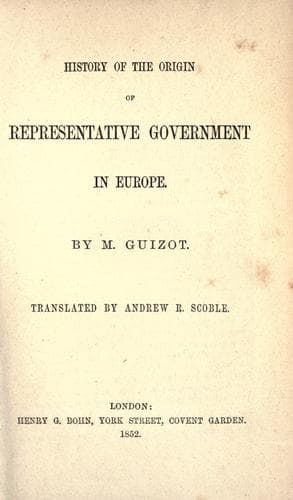
History of the Origin of Representative Government in EuropeGuizot, François
History
History of the Origin of Representative Government in Europe
Guizot, François
Europe -- History; Representative government and representation
Nothing of the kind occurred in England in the eleventh century,
in consequence of the Norman Conquest. A Barbarian people which
had already been established in a country for two hundred years
conquered another Barbarian people which had been territorially
established for six hundred years. For this reason, many decisive
differences may be observed between this conquest and those which
took place on the Continent.
{282}
Resemblance Of The Two Peoples.
1. There was much more resemblance, and consequently much more
equality, between the two peoples; their origin was the same,
their manners and language were analogous, their civilization
was almost identical, and the warlike spirit was as powerful
among the vanquished as among the victors. Thus, two nations
under almost similar conditions, found themselves in presence
of one another, and the conquered nation was able, as well as
disposed, to defend its liberties. Hence arose many individual
evils, but no general and permanent abasement of one race
before the other. Oppressed at first, but retaining its warlike
character, the Saxon race offered an energetic resistance, and
gradually raised itself from its inferior position.
2. The two peoples also possessed political institutions of a
singularly analogous nature, whereas elsewhere, in France and
in Italy, the Roman populations, to speak the truth, possessed
no institutions at all. The communes and the clergy were
required to maintain, even obscurely, the Roman law among
societies on the Continent; whereas in England, Saxon
institutions were never stifled by Norman institutions, but
associated with them, and finally even changed their character.
On the Continent, we behold the successful sway of barbarism,
feudalism, and absolute power, derived either from Roman or
ecclesiastical ideas. In England, absolute power was never able
to obtain a footing; oppression was frequently practised in
fact, but it was never established by law.
3. The two peoples professed the same religion; one had not to
convert the other. On the Continent, the more Barbarian victor
adopted the religion of the vanquished, and the clergy were
almost entirely Romans; in England, they were both Saxons and
Normans. Hence resulted an important fact. The English clergy,
instead of enrolling themselves in the retinue of the kings,
naturally assumed a place among the landed aristocracy, and in
the nation. Thus the political order has almost constantly
predominated in England over the religious order; and ever
since the Norman Conquest, the political power of the clergy,
always called in question, has always been on the decline.
{283}
Sources Of The English Government.
Public-domain text, read in full here on John Shaqi.
Reviews
Reviews
No reviews yet
Be the first to share your thoughts on this work.
Elsewhere in the archive
Join the Discussion
Join the discussion
Sign in to leave a comment or review.
Sign InorCreate an account