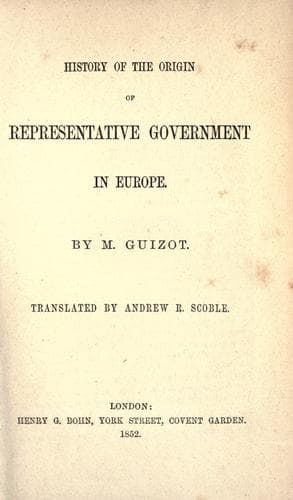
History of the Origin of Representative Government in EuropeGuizot, François
History
History of the Origin of Representative Government in Europe
Guizot, François
Europe -- History; Representative government and representation
After the Conquest and their territorial establishment, the bonds
which united the Norman aristocracy were necessarily drawn still
closer together. Encamped in the midst of a people who regarded
them with hostility and were capable of vigorous resistance, the
conquerors felt the need of unity; so they linked themselves
together, and fortified the central power. On the Continent,
after the Barbarian invasions, we hear of hardly any
insurrections of the original inhabitants: the wars and conflicts
are between the conquerors themselves; but in England they are
between the conquerors and the conquered people. We indeed meet,
from time to time, with revolts of the Norman barons against the
king; but these two powers generally acted in concert, for their
interest was their bond of union.
{286}
Moreover, William had found a royal domain of large extent,
already in existence: and it received immense increase from
confiscations of the lands of Anglo-Saxon rebels. Although the
spoliation was not universal, it was carried out with unexampled
promptitude and regularity. William soon had 600 direct vassals,
nearly all of whom were Normans, and his landed property was
divided into 60,215 knight's fees, a large quantity of which
frequently belonged to the same master; for example, Robert de
Mortaigne alone possessed 973 manors, the Earl of Warrenne 278,
and Roger Bigod 123; but they were all scattered through
different counties, for though the prudent William was willing to
make his vassals rich, he was not desirous of making them too
powerful.
Cohesion Of The Norman Aristocracy.
Another proof of the cohesion of the Norman aristocracy is
supplied by the Doomsday Book; a statistical account of the royal
fiefs, and register of the demesne lands and direct vassals of
the king, which was begun in 1081 and terminated in 1086: it was
compiled by royal commissioners. King Alfred had also directed
the compilation of a similar register, but it has been lost.
Nothing of the kind was ever done in any other country.
Public-domain text, read in full here on John Shaqi.
Reviews
Reviews
No reviews yet
Be the first to share your thoughts on this work.
Elsewhere in the archive
Join the Discussion
Join the discussion
Sign in to leave a comment or review.
Sign InorCreate an account