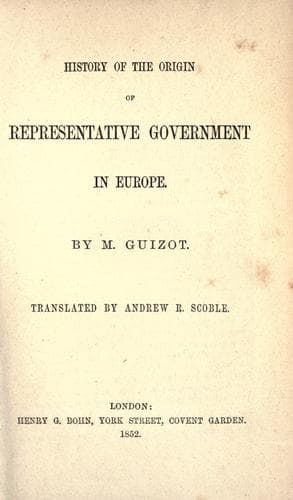
History of the Origin of Representative Government in EuropeGuizot, François
History
History of the Origin of Representative Government in Europe
Guizot, François
Europe -- History; Representative government and representation
The same cause which rendered Norman feudalism in England more
compact and regular than on the Continent, produced a
corresponding effect upon the Saxons. Oppressed by a powerful and
thoroughly united enemy, they formed in serried ranks,
constituted themselves into a national body, and clung resolutely
to their ancient laws. And in the first instance, the
establishment of William did not appear to have been entirely the
work of force; there were even some forms of election; after the
battle of Hastings, the crown was offered to him by the Saxons,
and at his coronation at Westminster, he swore to govern the
Saxons and Normans by equal laws. After this period, we
incessantly find the Saxons claiming to be ruled by the laws of
Edward the Confessor, that is to say, by the Saxon laws, and they
obtained this right from all the Norman kings in succession.
These laws thus became their rallying point, their primitive and
permanent code. The county-courts, which continued to exist, also
served to maintain the Saxon liberties.
{287}
Feudal jurisdiction had made but little progress among the
Saxons; it received extension on the arrival of the Normans; but
it had no time to strike deep root, for it found itself limited
on the one hand by the county-courts, and on the other by the
royal jurisdiction. On the Continent, the royal authority
conquered judicial power from feudalism; in England, the royal
authority was superimposed upon the county-courts. Hence arises
the immense difference between the two judicial systems.
Lastly, the Saxons still possessed landed property, which they
defended or claimed in reliance upon titles anterior to the
Conquest, and the validity of these titles was recognised.
Results Of The Norman Conquest.
To sum up the whole matter, the Norman Conquest did not destroy
right among the Saxons, either in political or civil order. It
opposed in both nations that tendency to isolation, to the
dissolution of society and of power, which was the general course
of things in Europe. It bound the Normans to one another, and
united the Saxons among themselves; it brought them into presence
of each other with mutual powers and rights, and thus effected,
in a certain measure, an amalgamation of the two nations and of
the two systems of institutions, under the sway of a strong
central power. The Saxons retained their manners as well as their
laws; their interests were for a long time interests of liberty,
and they were able to defend them. This position, far more than
the intrinsic character of Saxon institutions, led to the
predominance of a system of free government in England.
{288}
Lecture IV.
The English Parliament in the earliest times of the
Anglo-Norman Monarchy.
Different names given to the King's Great Council.
Its characteristics.
Its constitution.
Opinions of Whigs and Tories on this subject.
Powers Which Rule Society.
Public-domain text, read in full here on John Shaqi.
Reviews
Reviews
No reviews yet
Be the first to share your thoughts on this work.
Elsewhere in the archive
Join the Discussion
Join the discussion
Sign in to leave a comment or review.
Sign InorCreate an account