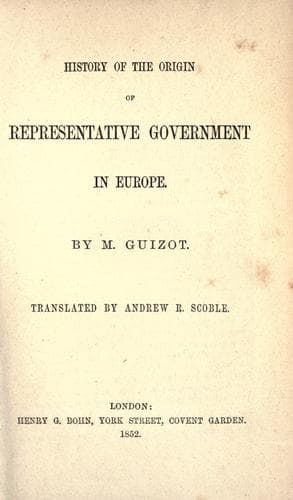
History of the Origin of Representative Government in EuropeGuizot, François
History
History of the Origin of Representative Government in Europe
Guizot, François
Europe -- History; Representative government and representation
During three centuries these powers have tended to centralization
in France; so much so, that if we would study the government of
the country we must attend to them all, for they were all united
and limited to the same individuals. Richelieu, Louis XIV, the
Revolution, Napoleon, though in different positions, seem to have
inherited the same projects and moved in the same direction. Such
has not been the case in England. The administrative power there,
for example, is to the present time divided and subdivided; it
belongs either to those who are themselves interested in its
movements, or to local magistrates, independent of the central
power of the State, and forming no corporation among themselves.
The judicial power itself is divided. It was so to some extent,
through another and stronger cause, in the earlier times of
England's social life, as in all societies which have made but
small advancement. Different powers are then not only distributed
but commingled. The legislative power is no more central than
others: its functions are continually usurped by local powers.
Judicial power is almost entirely local. Centralization commences
with the executive power properly so called, and this for a long
time remains the only one in which any centralizing tendency is
found. The proof of this is furnished by the feudal system, when
almost all powers--those connected with justice, militia, taxes,
&c.--were local, although the feudal hierarchy had at its head
the king, and the assembly of the most important possessors of
fiefs.
In this distribution and confusion of powers at the period we are
considering, the institutions which we have especially to study
in order to find the origin of representative government, are
those which were central, that is to say, the Parliament and the
king. On the Continent, centralization has resulted from an
absolute power which has broken up and absorbed all local powers.
In England, on the other hand, local powers have subsisted after
a thousand vicissitudes, while they have increasingly regulated
and defined their own action. A central government has emanated
from them by degrees--it has progressively formed and extended
itself. We shall trace this formation step by step, and shall
only study local institutions as they relate to this one fact;
and we shall see that this circumstance has been the principal
cause of the establishment of a free government in England.
{290}
The Anglo-Norman Parliament.
Public-domain text, read in full here on John Shaqi.
Reviews
Reviews
No reviews yet
Be the first to share your thoughts on this work.
Elsewhere in the archive
Join the Discussion
Join the discussion
Sign in to leave a comment or review.
Sign InorCreate an account