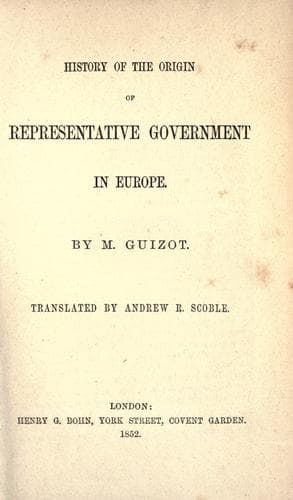
History of the Origin of Representative Government in EuropeGuizot, François
History
History of the Origin of Representative Government in Europe
Guizot, François
Europe -- History; Representative government and representation
It is easily presumed that, in such a state of society, no other
central institution, properly so called, existed for a long time,
except royalty. There are certain maxims, certain habits of
central political action, but no constant rule: the facts are
varied and contradictory. Men of considerable influence, almost
sovereigns in their own domains, are much less desirous of any
participation in the central power; they rather attempt to defend
themselves from it as often as it infringes upon their interests,
than endeavour at all to control it beforehand, and to act upon
it in a general manner. As in France, at the end of the
Carlovingian dynasty, a king can hardly be met with, so in
England, under the first Norman kings, a Parliament can hardly be
found. That which existed bearing any resemblance to one differs
but little from the Saxon Wittenagemot in the form which belonged
to it immediately before the Conquest, or from the Council of
Barons in Normandy. We find in the works of historians, and in
charters, the following names: _Curia de more, Curia regis,
Concilium, Magnum Concilium, Commune Concilium, Concilium
regni_. But these are to be regarded only as vague expressions
which designate assemblies, without giving any clue by which to
determine their constitution and their power. Hale sees in them
"a Parliament as complete and as real as has ever been held in
England." Carte and Brady see in them only tribunals, privy
councils dependent upon the king, or pompous gatherings for the
celebration of certain solemnities. It will be better for us to
examine each of these words, and seek for the actual facts which
correspond to them in the period to which our attention is
directed.
According to the Tories in general, the words _Curia de more,
_or _Concilium, Curia regis, Magnum_ or Commune
Concilium, represent different assemblies. _Concilium_ is a
privy council composed of men chosen by the king to serve him in
the government. This _Concilium_ was at the same time
_Curia regis_, a tribunal to judge of matters brought before
the king, and presided over by him, or, in his absence, by the
chief justice. It was called also _Curia de more_, because
its assemblies were held, according to ancient usage, three times
in the course of the year, at Easter, Whitsuntide, and Christmas,
and was even adjourned regularly from one period to another, as
is done to the present day by the Courts at Westminster.
{291}
According to the Whigs, all these words originally designated,
and continued to the reign of Henry II. (1154-1189) to designate
the general assembly of the nobles of the kingdom, who
necessarily assembled before the king in order to try cases, to
make laws, and to give their concurrence to the government.
The first of these opinions puts too great a restraint upon the
meaning of the words; the second generalizes too much on isolated
facts, and assigns to them an importance which does not belong to
them.
The Curia De More.
Public-domain text, read in full here on John Shaqi.
Reviews
Reviews
No reviews yet
Be the first to share your thoughts on this work.
Elsewhere in the archive
Join the Discussion
Join the discussion
Sign in to leave a comment or review.
Sign InorCreate an account