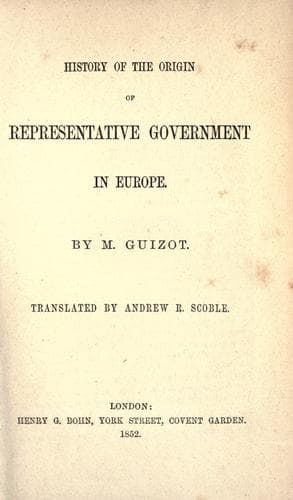
History of the Origin of Representative Government in EuropeGuizot, François
History
History of the Origin of Representative Government in Europe
Guizot, François
Europe -- History; Representative government and representation
A little consideration will show us the inferences to be drawn
from all these facts. At this period the legislative and judicial
powers were not separated; both of them belonged to the assembly
of the nobles, as they had previously belonged to the
Wittenagemot of the Saxons. When deliberations with reference to
a subject or personage of importance were required, this was the
assembly that judged, as it interposed on all great occasions in
the government. Thus all these different expressions denote
originally the same assembly, composed of the nobles of the
kingdom who were called to bear their share in the government.
How did they interpose? What power, what functions belonged to
them?--these are questions which were futile at that time: for no
one then had determinate functions, but everything was decided
according to fact and necessity. The facts are these: "It was the
ancient usage that the nobles of England should at Christmas time
meet at the king's court, either to celebrate the festival, or to
pay their respects to the king, or to deliberate concerning the
affairs of the kingdom."
{293}
We find that these assemblies were occupied in legislation, in
ecclesiastical affairs, in questions of peace and war, in
extraordinary taxes, in the succession of the crown, in the
domestic affairs of the king, his marriage, the nuptials of his
children, dissensions in the royal family, in one word, in all
matters of government, says Florence of Worcester, whenever the
king did not feel himself strong enough to settle them without
the assistance of the general assembly, or when the mode in which
he had settled them had excited complaints in sufficient number
to admonish him of the necessity of taking the advice of others.
Tenure Of These Assemblies.
As to the holding of these assemblies, they were not regular: the
Whigs have attached too much importance to the three periods
mentioned as the times of their annual convocation: these
gatherings were rather of the nature of solemnities, or
festivals, than public assemblies. The king at that time
considered it very important that he should exhibit himself
surrounded by numerous and wealthy vassals, _species
multitudinis;_ his force and dignity were thereby displayed,
just as that of every baron was exhibited in his own dominions.
Besides, under Henry II. and Stephen, these three epochs ceased
to be regularly observed. The Tories, on the other hand, not
considering the gatherings called _Curiæ de more_ and
_Curiæ regis_ as political assemblies, have represented them
as extremely infrequent, which they were not; there is not a
single reign, from the Conquest to the times of King John, in
which several instances of them are not to be found; only there
was nothing settled and fixed in this respect.
Constitution Of These Assemblies.
Public-domain text, read in full here on John Shaqi.
Reviews
Reviews
No reviews yet
Be the first to share your thoughts on this work.
Elsewhere in the archive
Join the Discussion
Join the discussion
Sign in to leave a comment or review.
Sign InorCreate an account