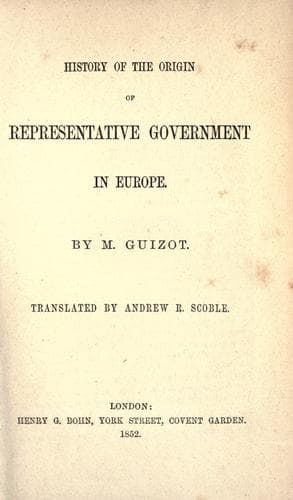
History of the Origin of Representative Government in EuropeGuizot, François
History
History of the Origin of Representative Government in Europe
Guizot, François
Europe -- History; Representative government and representation
The question of the constitution of these assemblies remains.
Historians and charters say nothing definite on this point: they
speak of their members as _magnates, proceres, barones_,
sometimes as_milites, servientes, liberi homines_. There is
every reason to suppose that the feudal principle was here
applied, and that, as a matter of right, all the immediate
vassals of the king owed to him service at court as well as in
war. On the other hand, the number of the vassals attached to the
crown under William I. exceeded 600; and there is no reason for
believing that all these would present themselves at the
assembly, nor are there any facts to indicate that they did so.
It had already become, for the most part, rather an onerous
service than a right; accordingly they only presented themselves
in small numbers.
{294}
The word most frequently employed is _barones:_ it would
appear to have been originally applied to all the direct vassals
of the crown, _per servitium militare_, by knightly service;
we find that the use of the word was limited more and more till
it was applied almost exclusively to those vassals of the crown
who were sufficiently wealthy and large proprietors to have a
court of justice established in the seat of their barony. It is
even difficult to admit that this last principle was generally
followed. The name of _barones_ was finally applied only to
those immediate vassals who were so powerful that the king felt
himself obliged to convoke them. There was no primitive and
constant rule to distinguish the barons from other vassals; but a
class of vassals was gradually formed who were more rich, more
important, more habitually occupied with the king in affairs of
state, and who came at last to arrogate to themselves exclusively
the title of barons.
The bishops and abbots also formed part of these assemblies, both
as being heads of the clergy, and as immediate vassals of the
king or of the barons.
No trace of election or of representation is to be found, either
on the part of the king's vassals who did not present themselves
at the assembly, or on the part of the towns. These last had in
general suffered very greatly by the Norman Conquest. In York the
number of houses was reduced from 1607 to 967; in Oxford from 721
to 243: in Derby from 243 to 140; in Chester from 487 to 282.
These, then, are the essential facts which we may gather with
reference to the constitution and power of the King's Court, or
general assembly of the nobles of the nation. We see how little
influence must have been exerted by an assembly of so irregular a
character; and we shall see this still more strikingly
illustrated when we have brought it into comparison with the
rights, the revenues, and all the powers which were at that time
enjoyed by royalty.
{295}
Lecture V.
The Anglo-Norman royalty: its wealth and power.
Comparison of the relative forces of the Crown and of the
feudal aristocracy.
Progress of the royal power.
Public-domain text, read in full here on John Shaqi.
Reviews
Reviews
No reviews yet
Be the first to share your thoughts on this work.
Elsewhere in the archive
Join the Discussion
Join the discussion
Sign in to leave a comment or review.
Sign InorCreate an account