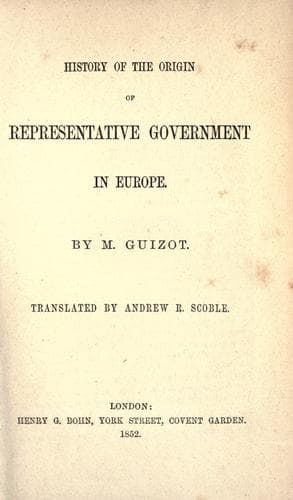
History of the Origin of Representative Government in EuropeGuizot, François
History
History of the Origin of Representative Government in Europe
Guizot, François
Europe -- History; Representative government and representation
Spirit of association and resistance among the great barons.
Commencement of the struggle between these two political forces.
Wealth Of The King.
In order to judge accurately of the power and importance of
royalty at the period we are considering, we must first ascertain
its actual position and resources; and we shall see by the extent
of these resources, and by the advantages of this position, how
feeble in its action on the royal power must have been the
influence of the assembly of barons.
The riches of the Norman king were independent of his subjects;
he possessed an immense quantity of domains, 1,462 manors, and
the principal towns of the kingdom. These domains were
continually being augmented, either by confiscations, causes for
which were of frequent occurrence, or by the failure of lawful
heirs. The king gave lands on a free tenure to those cultivators
who would pay for them a determinate rent (_free socage
tenure_). This was the origin of most of the freeholders,
whether in the king's domains or in those of his barons. The
king, in his domains, imposed taxes at will; he also arbitrarily
imposed custom-house regulations on the importation and
exportation of merchandize; and he fixed the amount of fines and
of the redemption money for crimes. He sold public offices, among
others that of sheriff, which was a lucrative one on account of
the share in fines which belonged to it. The county sometimes
would pay for the right to nominate its sheriff, or to avoid a
nomination already made. Lastly, the sale of royal protection and
justice was a source of considerable revenue.
{296}
Duties Of The Royal Vassals.
As to the immediate vassals of the king, they owed him,
_First_, a military service of forty days whenever it was
required;
_Secondly_, pecuniary aid under three circumstances,--to
ransom the king when made prisoner, to arm his eldest son as a
knight, or to marry his eldest daughter. The amount of this aid
was undetermined up to the reign of Edward I.; it was then
fixed at twenty shillings for the fief of a knight, and as much
for every twenty pounds sterling value in land held in socage
tenure.
_Thirdly_, the king had a right to receive from his
vassals a relief or fine on the death of the possessor of a
fief; he was guardian if the heir were a minor, and enjoyed all
the revenues of the fief till the majority of the heir; he also
had a control over their marriages, that is to say, the vassal
of a king could not marry without his consent. All these rights
were indeterminate, and negotiations were substituted for them
in which the greater force always had the advantage.
Public-domain text, read in full here on John Shaqi.
Reviews
Reviews
No reviews yet
Be the first to share your thoughts on this work.
Elsewhere in the archive
Join the Discussion
Join the discussion
Sign in to leave a comment or review.
Sign InorCreate an account