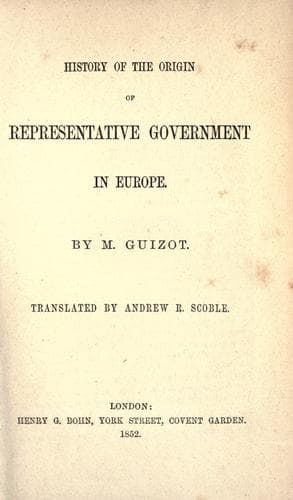
History of the Origin of Representative Government in EuropeGuizot, François
History
History of the Origin of Representative Government in Europe
Guizot, François
Europe -- History; Representative government and representation
When we consider these facts collectively, we may be led to two
very opposite results, according to the point of view from which
we regard them: on the one hand, we see the general assembly of
the nation interfering pretty frequently in public affairs, not
by virtue of any particular official character it possessed, nor
for the purpose of exercising any one special right, such as that
of making general laws, or of voting supplies, but on occasions
widely differing from one another, and for the purpose of
acquiescing in the entire course of government. Laws, external
relations, peace, war, ecclesiastical affairs, the judgment of
important cases, the administration of the royal domains,
nominations to great public offices, even the interior economy
and proceedings of the royal family, all seem to belong to the
province of this national assembly. No matter is foreign to it,
no function forbidden to it, no kind of investigation or of
action refused to it. All distinction of provinces, all lines of
demarcation between the prerogatives of the crown and those of
the assembly, appear to be unknown; we might say that the entire
government belonged to the assembly, and that it exercised in a
direct way that activity, that general supervision, which belongs
indirectly to the mature and perfected representative system, by
virtue of its influence on the choice of those who are to be the
depositaries of power, and by means of the principle of
responsibility.
On the other hand, if we forget the assembly and examine the
royal power, as isolated, we shall see it exercising itself in a
multitude of cases, in as absolute and arbitrary a manner as if
no assembly had existed to share in the government. The king, on
his own responsibility, made laws, levied taxes, dispossessed
proprietors, condemned and banished important persons, and
exercised, in a word, all the rights of unlimited sovereignty.
This sovereignty appears entire, sometimes in the hands of the
assembly, sometimes in those of the king; when the assembly
proceeds to interfere in all the details of government, we do not
find any complaint from the king, as if an encroachment had been
made on his prerogatives; and when, on the other hand, the king
governs despotically, we do not find the assembly bestirring
itself to protest against the extension of royal power, as a blow
aimed at their rights.
{299}
Co-existence Of Opposing Forces.
Thus we are met by two classes of facts, simultaneously existing
in this infancy of society,--facts which seem to belong to a
fully developed system of free institutions, and facts which are
characteristic of absolute power. On the one hand, the aim of
free governments, which is, that the nation should interfere,
directly or indirectly, in all public affairs, seems to be
attained; on the other hand, the independent and arbitrary
domination of the royal power appears to be recognized.
Public-domain text, read in full here on John Shaqi.
Reviews
Reviews
No reviews yet
Be the first to share your thoughts on this work.
Elsewhere in the archive
Join the Discussion
Join the discussion
Sign in to leave a comment or review.
Sign InorCreate an account