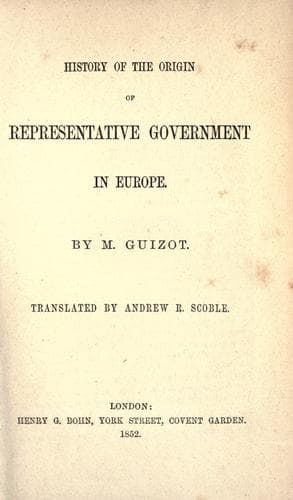
History of the Origin of Representative Government in EuropeGuizot, François
History
History of the Origin of Representative Government in Europe
Guizot, François
Europe -- History; Representative government and representation
This is a result that must necessarily arise in the disorder of a
nascent and troubled stage of civilization. Society is then a
prey to chaos;--all the rights and all the powers of a community
co-exist, but they are confounded, unregulated, unmarked by
limits, and without any legal guarantee;--freemen have not yet
abdicated any of their liberties, nor has force yet renounced any
of its pretensions. If any one had said to the barons of William,
or of Henry I., that they had nothing to do with affairs of
State, except to comply when the king demanded an impost, they
would have been indignant. All the affairs of the State were
theirs, because they were interested in them; and when they were
called upon to deliberate concerning peace or war, they believed
that they were exercising a right belonging to them, and not
making a conquest over royal authority. No freeman, who was
strong enough to defend his freedom, recognized any right in
another person to dispose of him without his consent, and found
it a very simple matter to give his advice on questions that were
interesting to him. The king, in his turn, measuring his right by
his force, did not recognize in any person, nor, consequently, in
any assembly, the legal right to prevent him from doing that
which he was able to do. There were then, properly speaking, no
public rights or powers at all; they were almost entirely
individual and dependent on circumstances; they are to be found,
but in a state of isolation, unconscious of their own nature,
and, indeed, of their very existence.
{300}
Origin Of Royal Prerogative.
In this disorderly state of things, the able and energetic
government of William I., Henry I. and Henry II. caused the royal
power gradually to assume a much more general and consistent
character. Accordingly, national assemblies became by degrees
more rare and less influential; under Stephen, they almost
entirely disappeared. The barons no longer had a common
meeting-point, and were more occupied with the rule of their own
domains than with any association with the royal power for the
purpose of controlling or restraining it. Each devoted himself
more exclusively to his own affairs, and the king, following this
example, made himself almost the sole master of those of the
State. He availed himself of the need of order and regularity
that made itself felt every day, in order to constitute himself,
in some sort, the dispenser of them. By these means he soon
became the first in name, as well as the most powerful in fact.
Through him, the roads became more secure; he protected the
feeble, and repressed robbers. The maintenance of public order
devolved upon the royal power, and became the means of extending
and strengthening it more and more. Whatever the king had
possessed himself of by conquest, he vindicated as his own by
right. Thus was formed the royal prerogative.
The Barons And The King.
Public-domain text, read in full here on John Shaqi.
Reviews
Reviews
No reviews yet
Be the first to share your thoughts on this work.
Elsewhere in the archive
Join the Discussion
Join the discussion
Sign in to leave a comment or review.
Sign InorCreate an account