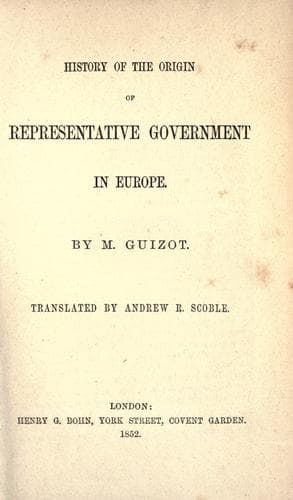
History of the Origin of Representative Government in EuropeGuizot, François
History
History of the Origin of Representative Government in Europe
Guizot, François
Europe -- History; Representative government and representation
But at the same time different circumstances concurred to draw
the barons forth from their isolation, to unite them among
themselves, and to form them into an aristocracy. The
Anglo-Norman throne was successively occupied by three usurpers,
William II., Henry I., and Stephen. Invested with a power whose
title was doubtful, they felt the necessity of bringing the
barons to recognize their claims; hence the first charters were
conceded. No one of the barons was powerful enough, in himself,
to restrain the threatened extension of royal power, but they
formed the habit of making coalitions; and as each of the barons
entering into such coalitions, felt the necessity of attaching
his vassals to himself, concessions were made to them also. The
absence of large fiefs, in England, served the cause both of
power and of liberty; it allowed power to form itself into unity
with greater facility, and it obliged liberty to seek for
guarantees in the spirit of association.
{301}
That which finally contributed in the most decided way to form
and consolidate this aristocratic coalition, was the irregular
and usurping conduct of John during the long absence of Richard
Cœur-de-Lion, and the disorders and civil wars which were
naturally the results of this absence. In the midst of these
disorders the government fell into the hands of a council of
barons, that is to say, of a portion of the aristocracy. Those
who had no share whatever in the central power did not cease to
control it, and to regard it as rightfully theirs; in this way,
the one party formed a habit of governing, the other that of
resisting a government which was in the hands of their equals,
and not of the king himself. John, by his cowardice and
ill-judged familiarity, had brought the throne into disrespect
before he himself ascended it, and his barons much more easily
conceived the idea of resisting as a king, one whom they had
despised as a prince.
Thus, in the space of a hundred and thirty years, two elements in
the State, which were at first confounded and had almost acted in
common, were separated and formed into distinct powers,--the
royal power on the one hand, and on the other, the company of
barons. The struggle between these two forces then commenced, and
we shall see royalty continually occupied in defending its
privileges, and the aristocracy as unweariedly busying itself in
the endeavour to extort new concessions. The history of the
English charters, from the reign of William I. to that of Edward
I., who granted them a general confirmation, is the history of
this struggle, to which England is indebted for the earliest
appearance of the germs of a free government, that is to say, of
public rights and political guarantees.
{302}
Lecture VI.
History of English Charters.
Charter of William the Conqueror (1071).
Charter of Henry I. (1101).
Charters of Stephen (1135-1136).
Charter of Henry II. (1154).
Progress Towards Free Government.
Public-domain text, read in full here on John Shaqi.
Reviews
Reviews
No reviews yet
Be the first to share your thoughts on this work.
Elsewhere in the archive
Join the Discussion
Join the discussion
Sign in to leave a comment or review.
Sign InorCreate an account