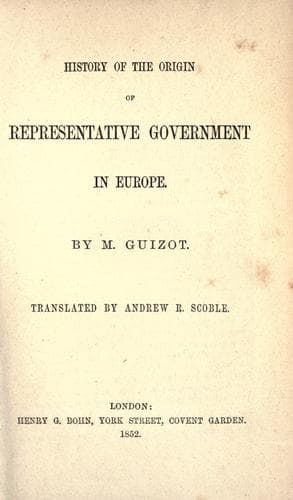
History of the Origin of Representative Government in EuropeGuizot, François
History
History of the Origin of Representative Government in Europe
Guizot, François
Europe -- History; Representative government and representation
John was not the lawful heir to the crown; it belonged to his
nephew, Arthur, Duke of Bretagne, whose rights were further
confirmed by a testament of Richard. Nevertheless, by his
largesses and his yielding disposition, John found no difficulty
in usurping the throne of England. The opposition was stronger in
his continental possessions; the feudal ideas there prevailing
favoured the system of representation, and the people were more
disposed to recognize the claims of a son than those of a
brother. Anjou, Poitou, Maine and Touraine declared for Arthur.
In 1201 (others say in 1204) John demanded of the barons, whom he
had assembled at Oxford, that they should assist him in the war
which he purposed carrying on in France. They required, as the
price of their assistance, that the king should promise to
restore to them their liberties and privileges. John, without
having granted anything to them, succeeded in winning over one
after another, until he had obtained from each individually what
had been refused to him by all when assembled. Nevertheless, this
opposition showed that the coalition among the barons had taken
shape and consistence.
John, who had as yet done nothing to deserve that his usurpation
should be overlooked, rendered himself odious by an imprudent
divorce, and by vexatious indignities. He introduced into his
retinue, bullies, whom he called champions of royalty; and he
obliged the discontented barons to enter into the lists with
them, and to settle, by these pretended judicial combats, their
disputes with the crown.
{310}
At length, his exactions, his tyrannical proceedings, and above
all, the murder of Arthur, whom he is said to have assassinated
with his own hand, excited against him an almost general rising.
Abandoned by his barons, driven from Normandy, Anjou, Maine,
Touraine, and a part of Poitou, John, instead of conciliating the
minds of his people, only acted in such a manner as to alienate
them more and more, and only defended himself by rendering
himself more odious. A new _escuage_ of two marks and a half
for every knight's fief was extorted from the barons. John had,
therefore, to endure a new refusal when he asked them a second
time to follow him to the Continent. In vain was it that he
employed those means which had before succeeded; he was obliged
to yield, and to allow Philip Augustus to take possession of
Normandy, and reunite it to the crown of France.
Quarrels With The Clergy.
Public-domain text, read in full here on John Shaqi.
Reviews
Reviews
No reviews yet
Be the first to share your thoughts on this work.
Elsewhere in the archive
Join the Discussion
Join the discussion
Sign in to leave a comment or review.
Sign InorCreate an account